
Greyhound St Leger
 Available in US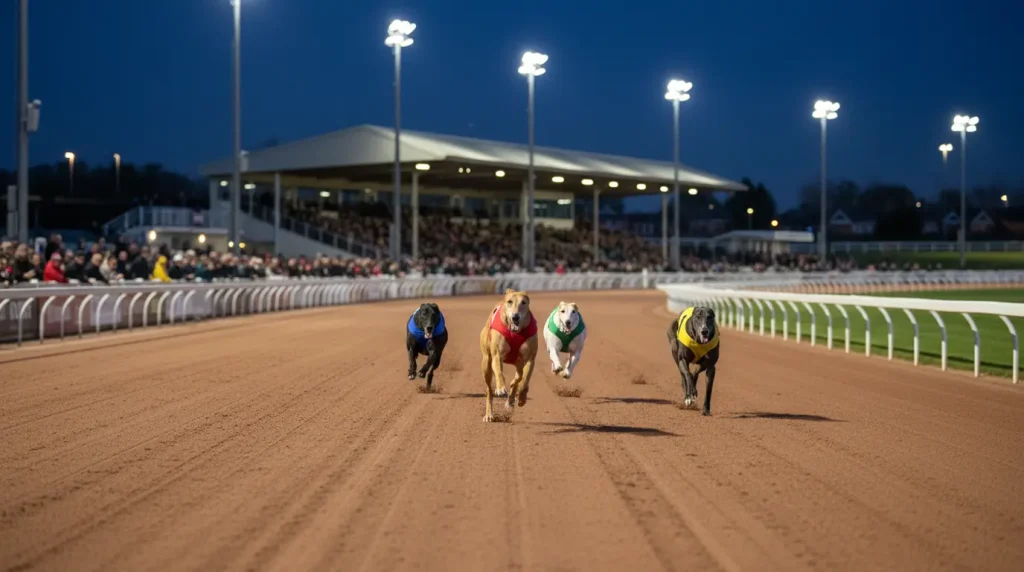
The St Leger — Greyhound Racing’s Stayers’ Classic
The Greyhound St Leger occupies a unique position in the UK racing calendar. It is the stayers’ championship — the premier event for greyhounds that race over middle and marathon distances — and it tests a set of qualities that the sprint and standard-distance classics do not: endurance, tactical patience, and the ability to sustain pace over a distance that separates the genuine stayer from the dog that merely hangs on.
First run in 1928, a year after the inaugural Greyhound Derby, the St Leger has a history almost as long as the sport itself. Its prestige within the racing community is second only to the Derby, and for trainers who specialise in staying dogs, winning the St Leger is the defining achievement. The race has produced champions whose names carry a particular reverence — dogs that did not just win at long distances but dominated, pulling away from the field in the final straight with the relentless momentum that characterises a true stayer.
The St Leger’s distance sets it apart from every other major event on the calendar. While the Derby tests speed over the standard trip, the St Leger asks a different question: which dog can maintain its effort over a distance that demands more than raw pace can provide? The answer reveals something fundamental about the dog’s character and physical capability, and the St Leger final, more than any other race in UK greyhound racing, rewards the dog that combines ability with determination.
Distance Demands and What They Reveal About a Dog
The St Leger is contested over a staying distance — traditionally around 660 to 710 metres, depending on the host venue’s track configuration. This is roughly fifty percent longer than the standard 480-metre trip, and the additional distance transforms the dynamics of the race. The first bend is still important, but it is not decisive. A dog that misses the break at the first turn has five or six more bends to recover, and the race develops a tactical dimension that shorter events do not allow.
Staying races expose physical attributes that are invisible at standard distances. Aerobic capacity becomes critical — the dog’s ability to process oxygen efficiently under sustained exertion determines whether it maintains speed through the middle stages of the race or decelerates progressively. Muscular endurance separates dogs that finish strongly from those that weaken after the fourth bend. And mental fortitude — the willingness to keep running hard when the body is tiring — is the intangible factor that distinguishes the champions from the merely competent.
The St Leger field typically includes a mix of confirmed stayers with established form at long distances and standard-distance dogs being stepped up to test their stamina. The confirmed stayers have the data advantage — their form at the distance is known — but they may lack the raw speed of the stepping-up dogs. The standard-distance entries carry uncertainty: they might possess untapped stamina that the shorter trips have not tested, or they might find the extra distance beyond their physical range. This tension between known stayers and speculative entrants is what makes the St Leger such a compelling betting event.
Sectional times are particularly revealing in the St Leger context. A dog whose middle-race splits remain strong — maintaining pace through bends three, four, and five when other dogs are decelerating — is demonstrating the sustained aerobic output that staying success requires. Conversely, a dog whose sectionals show a sharp decline after the halfway point may be reaching the limit of its stamina, regardless of how fast it was through the early stages.
The St Leger’s Venue History — From Wembley to Perry Barr
The Greyhound St Leger was staged at Wembley Stadium from 1928 until 1998, then moved to Wimbledon Stadium from 1999 until 2016. Following Wimbledon’s closure, the race relocated to Perry Barr in Birmingham, which hosted the St Leger from 2017 through 2026. For the 2026 renewal, the race moved to Nottingham as a one-off arrangement while Perry Barr’s greyhound racing operations relocated to Wolverhampton. The circuits at these various venues have been well suited to staying events — the track dimensions allow a true test of stamina without the distortion that tighter circuits can introduce, where bend speed becomes disproportionately important relative to sustained pace.
The host tracks have offered fair racing surfaces with bends that reward smooth, efficient running rather than explosive acceleration. Stayers tend to run wide through the turns, using a longer arc to maintain momentum, and the geometry of these venues accommodates this running style without severely penalising outside runners. This produces competitive racing where the best dog — rather than the best-drawn dog — has a realistic chance of winning, which is precisely what a championship event should deliver.
Finals night draws a strong crowd, and the card is structured around the St Leger as the centrepiece, with the undercard building towards the championship race. The betting market for the St Leger final is among the most active of the year for a non-Derby event, with bookmakers offering competitive odds and the exchange markets showing genuine liquidity.
Many St Leger contenders have existing form at the host venue due to its regular racing schedule. Dogs that have raced at the track before the competition begins carry a home advantage of sorts — they know the traps, the surface, and the bends, which reduces the adaptation factor that affects runners visiting an unfamiliar venue. For the bettor, checking whether a St Leger entry has prior course form is a basic due-diligence step that can separate runners with genuine course experience from those encountering the track for the first time.
Betting the St Leger — Stamina Over Speed
The fundamental betting principle for the St Leger is that stamina is the dominant variable. A dog’s standard-distance time is relevant but not decisive — a 29.30 dog over 480 metres is not automatically better positioned for the St Leger than a 29.80 dog, if the slower dog has proven ability to maintain its pace over the additional two or three hundred metres. The St Leger rewards dogs that are built for the trip, and the market sometimes misprices this by giving too much weight to standard-distance form.
Previous staying form is the strongest predictor of St Leger performance. Dogs with a record of winning or placing in staying events — particularly at Category 1 or 2 level — have demonstrated the specific qualities the race demands. Their form at distance is tested data, not speculation. Backing confirmed stayers in the St Leger is a lower-variance approach than backing speed-oriented dogs being tried at an extended trip, and the confirmed stayers tend to be undervalued in ante-post markets where the wider public gravitates towards better-known names from standard-distance racing.
The qualifying rounds provide critical information for the final. Each round is run at the full staying distance, which means that by the semi-final stage, every surviving dog has been tested over the trip at the specific venue. Comparing the sectional data from the rounds — identifying which dogs maintained their pace best in the closing stages, which dogs finished strongest, which dogs benefited from a kind draw rather than genuine superiority — produces a clearer picture of the finalists’ relative merits than the headline finishing times alone.
Pace analysis matters more in the St Leger than in any standard-distance event. A final with two or three confirmed front-runners creates a fast early pace that favours closers — the leaders burn energy through the early bends and may tire in the closing stages, opening the door for a dog that has conserved its resources. A final with a single front-runner and five hold-up dogs creates a slower pace that favours the leader, which can dictate the race unchallenged. Predicting the likely pace scenario and identifying which dogs it benefits is the analytical edge that separates sharp St Leger betting from passive observation.
The Last Bend Belongs to the Brave
Staying races are decided in the final third. The first four bends establish positions, but the last two bends and the finishing straight determine the order. This is where the stayer’s character is revealed — the willingness to keep running when the muscles are flooding with lactate, when the lungs are burning, and when every instinct says slow down. The dog that accelerates off the final bend when others are decelerating is the dog that belongs at this distance.
The St Leger final, at its best, produces this exact moment: a closing run from a dog that has measured its effort perfectly, sweeping past tiring rivals in the straight to win going away. It is a different kind of drama from the Derby’s explosive speed — it is slower to build, more tactical, and often more satisfying to watch because the outcome is contested right to the line rather than determined at the first bend.
For the bettor who appreciates the stayers’ game — the patience, the long-range analysis, the reading of fitness and condition over speed and draw — the St Leger is the calendar’s most rewarding event. It asks the right questions of the right dogs, and it produces answers that feel earned rather than lucky.
Find more race guides at greyhoundmeetings.
Also read our English greyhound derby.
