
UK Greyhound Meetings — The Complete Betting & Form Guide
 Available in US
How the race schedule works, what the form data means, and where the value hides across daily fixtures.
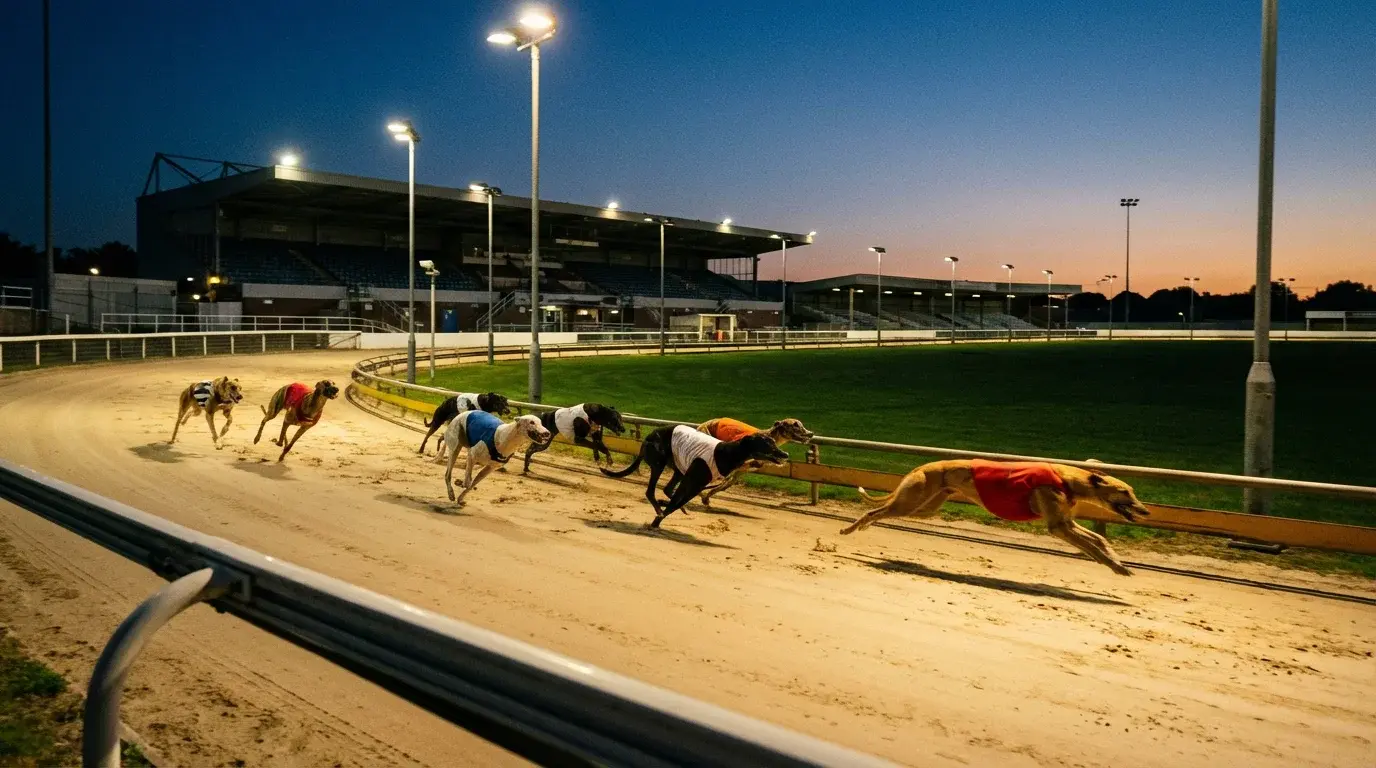
What a UK Greyhound Meeting Actually Looks Like
Greyhound meetings are the structural backbone of UK dog racing — several hundred fixtures each week across around 20 licensed stadiums, every one a self-contained event with its own racecard, grading structure, and live betting markets. This is not horse racing with smaller animals. The rhythm is different, the data is different, and the market dynamics are sharper, thinner, and faster. If you want to bet on the dogs with any kind of edge, understanding what a meeting actually is — and how it works from the inside — matters more than any tip sheet.
Walk into any licensed stadium on a Tuesday afternoon and you will see a card of 12 races pinned to the wall. Each race has six traps, a set distance, a grade that tells you the calibre of the field, and a set of odds that will shift right up until the hare starts moving. The whole programme runs in roughly two and a half hours, with races going off at intervals of around 15 minutes. There is no undercard, no supporting act. Every race is a betting event, and every race has a market.
The structure of a UK greyhound meeting has stayed remarkably consistent for decades, even as the sport has shifted towards a broadcast-and-betting model. Most meetings now exist primarily for the off-course market — punters watching via SIS or Sky Sports Racing and placing bets through bookmakers or exchanges. The atmosphere inside the stadium is part of the experience, but the real action lives on the screens and in the odds.
Greyhound meeting — a scheduled programme of races at a single GBGB-licensed track, typically comprising 10–13 races run over set distances and graded by class. Each meeting operates as its own fixture with a dedicated racecard, live betting markets, and broadcast coverage.
This guide breaks the meeting down piece by piece. From how the schedule works and what the grades mean, to the tracks themselves, the racecards, the bet types, and the form angles that actually produce results. Whether you are watching your first BAGS meeting on a Wednesday lunchtime or studying the Greyhound Derby card, the mechanics are the same. The difference is in how deeply you read them.
Anatomy of a Greyhound Meeting — From First Race to Last
Every meeting follows a rhythm: a sequence of races at fixed intervals, each with its own class, distance, and market. The structure is not random. Race planners at each track build the card to create a spread of distances, grades, and competitive profiles across the programme. The aim is twofold — to give trainers appropriate races for their dogs, and to give bettors a varied set of markets through the evening or afternoon.
A typical card contains between 10 and 13 races. The first is usually a mid-grade event over a standard distance, and the card then alternates between sprints, standard trips, and longer staying races. Grade levels shift across the programme — an A3 480-metre race followed by a D2 sprint, then an A1 event. Each race is a distinct proposition, which is precisely why treating every race with the same approach is a mistake.
Between races, the track resets. Traps are loaded, the hare is positioned, and the market forms. At most tracks this happens on a 15-minute cycle, though some BAGS fixtures compress slightly to fit the broadcast window. That gives you roughly 10 minutes of usable time between races to assess the card, check the odds, and decide whether to engage. Experienced bettors treat the first two or three races as reconnaissance — the form book tells you about the dogs, but the live card tells you about the track on that specific day. Whether the surface is fast or holding, whether the rail is riding true, whether front-runners are being favoured or caught.
That overview covers the shape of a meeting. The next layer is timing and grading — the two structural elements that determine what kind of race you are actually looking at.
How the Daily Schedule Works
UK greyhound racing operates on a split-day model. Daytime meetings — almost exclusively BAGS fixtures — typically start between 10:30 and 11:00, running through early afternoon. Evening meetings kick off from around 18:30 or 19:00, wrapping up by 22:00. Saturday cards often start earlier, around 17:00, and some tracks schedule matinée meetings on weekends.
Races go off every 15 minutes, give or take. A 12-race card starting at 19:00 will have its final race at approximately 21:45. The consistency of this schedule is one of the things that makes greyhound betting operationally efficient — you know exactly when each race will happen, you can plan your card assessment accordingly, and there is no waiting around for parade rings or delayed starts. The hare moves, the traps open, and the race is over in under 30 seconds.
On any given weekday in 2026, there are usually between four and six meetings running across different tracks. The GBGB fixture list is published weekly, and racecards go live on aggregator sites like Timeform and Sporting Life by mid-morning. Saturdays are busier, with up to eight or nine meetings. The practical effect for bettors: there is always a race to watch and always a market open. Managing that volume — deciding which meetings to focus on rather than betting across all of them — is one of the first genuine skill tests in greyhound betting.
What Race Grades Mean for Bettors
Grading is the single most misunderstood element on a racecard. New bettors often ignore it entirely, treating every six-dog race as equivalent. They are not. The grading system is a classification framework that separates dogs by ability, and it has a direct impact on how competitive a race is, how likely the favourite is to win, and where the value lies in the market.
UK greyhound races use two main grading scales. The A-grade system — A1 at the top down to A11 at the bottom — covers standard distances, typically 450 to 500 metres. The D-grade system — D1 to D5 — covers sprint distances, usually 260 to 280 metres. Higher grades mean faster, more proven dogs. Lower grades mean dogs that are developing, declining, or simply not quick enough for the top level. There are also S-grades for stayers, OR grades for open races, and H-grades for handicaps, though these appear less frequently on standard cards.
Why does this matter for betting? Because the grade tells you something crucial about predictability. A1 and A2 races feature dogs with established form lines, consistent sectional times, and known running styles — the data is clean. At the other end, A8 to A11 races often feature younger dogs still finding their level, or inconsistent performers — the form is noisier, the outcomes harder to model, but the market prices are less efficient. Some bettors thrive in the lower grades for exactly that reason. Others prefer the top grades where the data is more reliable. The mistake is not making the choice consciously.
A-Grades
A1 (elite) to A11 (novice). Standard distances: 450–500m. Form tends to be more readable at higher grades.
D-Grades
D1 (top sprint) to D5 (lower sprint). Distances: 260–280m. Trap draw and early pace dominate outcomes.
Open / Handicap
OR (invitational, prize money events), H (staggered starts by ability). Different grading logic; different betting angles.
BAGS Meetings vs Evening Cards — Why It Matters
Two-thirds of UK greyhound racing happens when most people are at work. That is not an accident — it is the product of a commercial model built around the Bookmakers' Afternoon Greyhound Service, better known as BAGS. These daytime meetings exist primarily to supply live betting content to bookmakers and their off-course customers. They run every weekday, starting mid-morning, across a rotating roster of tracks.
BAGS meetings differ from evening cards in several important ways. The fields are typically drawn from lower to mid-grade dogs, with fewer open or feature races on the programme. The on-course attendance is minimal — sometimes literally a handful of people — because the meeting is designed for the broadcast feed, not the stadium experience. The betting markets reflect this too. Liquidity on BAGS races can be thinner than on prime evening fixtures, which means prices are more volatile and the gap between early odds and SP can be wider.
For bettors, BAGS meetings offer a specific kind of opportunity. Reduced attention from the general public means the markets are less efficiently priced. A dog dropping in class at a Tuesday lunchtime BAGS meeting at Sunderland is not attracting the same scrutiny as the same move at a Friday evening card at Romford. If you study BAGS cards properly — checking the form, the track conditions, how the card develops — you are competing against a smaller, often less informed pool.
Evening meetings carry a different profile. The grades tend to be higher, the fields more competitive, and the market deeper. Feature races — graded OR or carrying additional prize money — are more common on evening and Saturday cards. Sky Sports Racing and SIS provide live commentary, and the overall quality of racing is a step above the average BAGS fixture. The trade-off is that the market is sharper too. More eyes on the card means tighter prices and fewer obvious mispricings.
Note: BAGS meetings are the main source of daytime betting shop action — they run on a separate schedule to evening cards and are contracted directly between the tracks and the bookmakers. If you are betting during working hours, you are almost certainly betting on a BAGS fixture.
UK Greyhound Tracks at a Glance
Around 20 licensed stadiums make up the active UK greyhound track circuit — and whether you are betting on a BAGS card or an evening fixture, the track itself shapes everything. Each operates under GBGB regulation, but the similarities end there. Circuit dimensions, standard distances, bend tightness, surface type, and even the hare system vary from venue to venue, and those differences directly influence race outcomes. A dog that dominates at Nottingham over 500 metres might struggle over the same nominal distance at Romford, because the track geometry demands a different running style.
Knowing the tracks is not optional for serious bettors. Form data is always presented in the context of a specific venue. When you see a form line of 211432, those results might span three different tracks — and comparing a first at Towcester with a fourth at Monmore without adjusting for circuit differences is an analytical error that costs money.
The landscape of UK greyhound racing has shifted in recent years. Several historic venues have closed — Wimbledon, Hall Green, Belle Vue, Crayford, and Perry Barr — while new venues like Dunstall Park in Wolverhampton have opened. The remaining tracks have consolidated as both live venues and broadcast centres. The 2026 GBGB fixture list reflects this unevenly, with some tracks running four or five meetings per week while others host two or three. Knowing which tracks are busiest matters because it directly affects the quality and competitiveness of the cards.
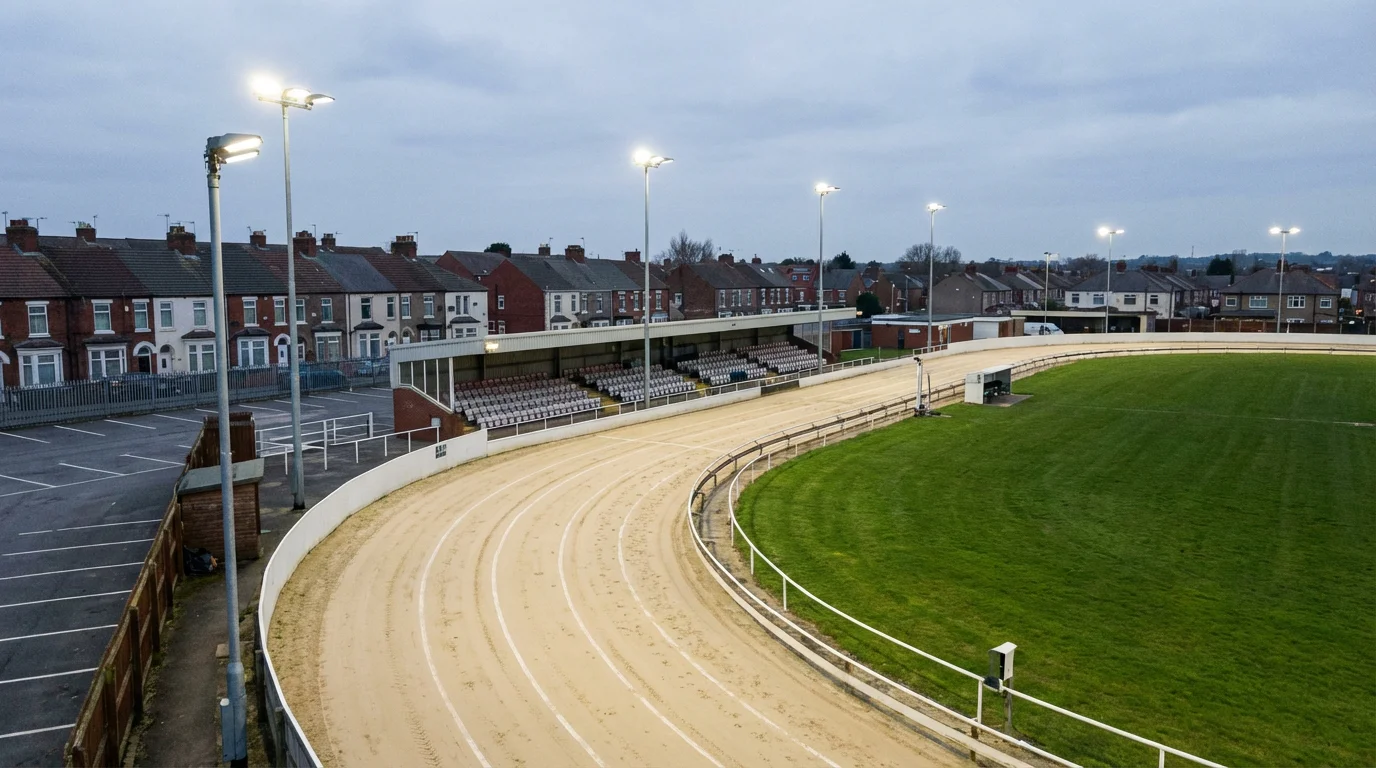
Romford
Tight 350m circuit with sharp bends. Standard distances: 225m, 400m, 575m. Known for favouring railers and early-pace dogs. The only remaining licensed greyhound venue in London.
Monmore Green
Galloping 419m circuit in Wolverhampton. Distances: 264m, 480m, 630m, 684m. Sweeping bends that suit wide runners. Strong evening card quality with competitive A-grade fields.
Nottingham
Large 437m circuit with long straights. Distances: 305m, 500m, 680m, 730m. Favours strong finishers and stayers. Regular host of the Select Stakes and other Category 1 events.
Towcester
Sweeping 420m oval circuit — wide bends designed with welfare in mind. Distances: 260m, 480m, 500m, 655m, 696m. The home of the English Greyhound Derby since its relocation. Layout rewards strong runners with its gentle bends and uphill finish.
Hove
Classic seaside oval, 460m circuit. Distances: 285m, 460m, 515m, 695m. Hosts the Sussex Cup and Regency. Balanced layout with a mix of tight and open running. Brighton and Hove is one of the oldest active tracks in the country.
Sunderland
Fast 450m circuit in the North East. Distances: 261m, 450m, 642m. Regular BAGS fixture host with good lower-grade racing. Trap 1 tends to perform well on the tight inside rail.
These six represent a cross-section, not the full list. Doncaster, Kinsley, Newcastle, Sheffield, Yarmouth, Central Park, and Dunstall Park each have their own characteristics worth studying. The point is universal: the track is not a neutral surface. It is a variable that shapes every race.
How Track Layout Affects Race Outcome
Tight bends reward different dogs than sweeping turns. This is the single most important principle in track analysis, and it plays out in every race at every stadium. On a tight circuit like Romford, dogs that break fast and secure a position on the inside rail have a significant structural advantage — the bends come quickly, and a dog running wide through a sharp turn loses ground that is almost impossible to recover over a short straight. At a galloping track like Monmore or Nottingham, the bends are more forgiving, and a dog with a strong finish can make up several lengths on the run-in.
The number of bends matters too. Most UK races involve four bends — two complete circuits. Sprint distances may only involve two bends, and some staying trips require six. The fewer the bends, the more dominant the trap draw and early pace become. In a two-bend sprint at Romford, the race is often decided in the first 50 metres. In a six-bend marathon at Nottingham, stamina and race intelligence take over.
Surface conditions add another layer. UK tracks use sand-based surfaces, and the going changes with weather. A rain-soaked surface slows times and can advantage heavier dogs; a dry, fast track favours lighter, speedier runners. Checking the going report — available on most racecard sites — takes five seconds and can reframe your entire assessment of a race.
The 60-Second Racecard Breakdown
You do not need ten minutes with a form book to assess a greyhound race — you need to know where to look. The racecard is a compressed data sheet, and once you learn how to read it, you can extract the information that matters in under a minute per race. That still gives you plenty of time between races to make a decision.
Every greyhound racecard follows a broadly similar layout. At the top is the race header: the time, the distance, the grade, and sometimes the race title if it is a named or sponsored event. Below that are six runners, one per trap, listed in trap order from 1 to 6. Each runner line carries the dog's name, the trainer, the owner, the trap colour, the dog's recent form figures, its best time at the distance, its sectional time to the first bend, and its current weight.

The key to speed-reading a card is prioritisation. For a standard graded race, the three most valuable data points are: recent form (the last six runs), the sectional time to the first bend, and the trap draw relative to the dog's running style. Everything else — weight, trainer, best time — is context. If you can assess those three points across all six runners in under a minute, you have enough to form a view.
Sample Racecard Line
Trap 3 (White) — Ballymac Flash
Trainer: P. Janssens | Weight: 32.4kg
Recent form: 2 1 1 4 3 2
Sectional: 17.52 | Best time: 28.91
Odds: 5/2
In that sample line, the form reads right to left — most recent run first. So Ballymac Flash finished second last time out, third before that, fourth, then two wins and a second in the three earlier runs. The pattern shows a dog that was in form, dipped, and has bounced back. The sectional time of 17.52 suggests decent early pace, and the best time of 28.91 is competitive for the grade. At 5/2, the market rates this dog as a contender but not the favourite. Whether that price represents value depends on the rest of the field.
One habit worth building: before you look at the odds, form your own view of the race from the card data. Then check the market. If your assessment and the market price are roughly aligned, there is probably no edge. If they diverge — if you think the 5/1 shot should be 3/1 — that is where the betting decisions happen.
Decoding Recent Form Lines
The numbers tell you where the dog finished; the pattern tells you whether it is improving. A form line of 111111 is obvious — the dog is winning everything. But that form line rarely appears at a price you would want to take. The interesting forms are the ones that require interpretation: 432211, for instance, shows a dog that started poorly and has improved steadily over its last six runs. That upward trajectory is often more valuable than a dog sitting on 211132, which suggests a runner that peaked a few races ago and may be on the way down.
Context matters enormously. A 5 at Towcester in an A2 race is not the same as a 5 at Sunderland in an A7. The grade, the track, and the competition level behind each result all feed into the interpretation. Experienced form readers cross-reference each run with the track and grade columns on the racecard. A form line stripped of context is just a string of numbers.
Letters in the form line carry specific meanings. M indicates the dog was brought down or impeded. W means a wide run, often costing lengths on the bends. T signals a trap failure. These are not finishes — they are interruptions and should be read differently. A dog showing 21M132 did not finish mid-pack in that third run; something went wrong. Ignoring the letter codes is one of the most common mistakes in greyhound form analysis.
What the Trap Draw Means in Practice
Trap 1 hugs the rail. Trap 6 runs wide. Neither guarantees anything — but both create tactical advantages and disadvantages that feed directly into race outcomes. The six traps are colour-coded (red, blue, white, black, orange, black-and-white stripes, from 1 to 6), and the draw determines each dog's starting position relative to the inside rail and the first bend.
On tight tracks, low trap numbers — particularly traps 1 and 2 — tend to outperform statistically because they have the shortest path to the first bend. A fast breaker from trap 1 at Romford can reach the rail before the field bunches, and the advantage compounds through every bend. High trap numbers need overwhelming early speed to cross the field, or the tactical ability to slot in behind and pick a run through. At wider, more galloping tracks the bias is less pronounced, but it never disappears.
Smart bettors cross-reference the trap draw with each dog's known running style. A dog that consistently runs wide and finishes strongly is less disadvantaged by trap 6 than a dog that needs the rail. A confirmed railer drawn in trap 5 faces a genuine obstacle. The racecard shows you the trap. The form lines — and particularly the sectional times — show you how each dog uses its position. Matching one to the other is where trap analysis becomes genuinely useful rather than just a number on the page.
Greyhound Bet Types You Should Actually Know
Ignore the exotic stuff until you have mastered these six. The core greyhound betting markets — the ones that account for the overwhelming majority of turnover — boil down to a handful of structures. Understanding when each one makes sense, and when it does not, matters more than memorising the mechanics of obscure pool bets you will rarely touch.
The fundamental split is between single-outcome bets and order-prediction bets. Win, place, and each-way are single-outcome markets: you back a dog to achieve a specific result. Forecast and tricast bets are order-prediction markets: you call the exact finishing positions of two or three dogs. The skill level, risk profile, and typical returns differ sharply across those two categories. Beyond them sit accumulators, trap challenge markets, and pool bets — each with its place, each carrying specific risks worth understanding before you commit your stake.
Win / Place / Each-Way
- Skill level: entry to intermediate
- Risk: lower — single outcome per bet
- Typical return: modest, consistent
- Best for: building a bankroll, steady approach
Forecast / Tricast
- Skill level: intermediate to advanced
- Risk: higher — exact order required
- Typical return: larger payouts, less frequent
- Best for: races where the form strongly suggests a finishing order
Win, Place, and Each-Way
Start here. A win bet is the simplest wager in greyhound racing: pick a dog, back it to finish first. If it wins, you collect at the quoted odds. If it does not, you lose the stake. There is no partial return, no consolation prize. The simplicity is the point — it forces you to commit to a single selection, which in turn forces you to do the work of assessing the field properly.
A place bet pays out if your selection finishes first or second. The odds are shorter — typically a quarter or a fifth of the win odds — but the probability of collecting is roughly doubled. In six-runner greyhound fields, place terms are tighter than in horse racing, so the each-way arithmetic is worth checking before you commit.
Each-way splits your stake into two equal parts: half on the win, half on the place. If the dog wins, both parts pay out. If it places, only the place half returns. This makes each-way a natural hedge in races where you fancy a dog at a bigger price — backing a 6/1 shot each-way gives you a return even if it misses the win by a nose. At shorter prices, each-way offers diminishing value, because the place return barely covers the total stake.
Forecast and Tricast Explained
Predicting the exact finishing order sounds harder than it is — if you know the draw. A straight forecast requires you to name the first and second-place finishers in the correct order. A reverse forecast covers both permutations (your two selections finishing first-second or second-first), doubling the stake. A combination forecast extends this to three or more selections across the first two places, covering every possible permutation.
Forecasts are where greyhound betting starts to reward genuine form knowledge. In a six-runner field where the form clearly separates two dogs from the rest, a straight forecast can offer significantly better returns than a win bet on the favourite. The key skill is identifying races where the top two in the market are genuinely the two most likely to fill the first two places — and deciding whether the order is predictable enough for a straight forecast, or whether the reverse is the safer play.
Tricast bets take the same logic a step further: name the first three finishers in exact order. Tricast dividends of 50/1 or higher are common, but the difficulty increases sharply. Combination tricasts cover all permutations of three selections (six combinations) or four selections (24 combinations), and the total stake rises accordingly. In practice, tricasts work best in races with a clear top three and a large gap to the remaining runners.
Accumulators, Trap Challenge & Pool Bets
Big payouts, thin margins. Accumulators chain two or more selections across different races, with returns from each winner rolling into the next leg. A four-fold at average odds of 3/1 per leg returns 255/1 if all four win. The catch is that a single loser kills the entire bet, and in a sport where the favourite wins roughly a third of the time, landing a four-fold is a low-probability event.
Trap challenge bets offer a different angle. The bookmaker prices which trap number will produce the most winners across a full meeting. You do not need to pick individual winners — just a pattern. The risk is that trap challenge markets are priced aggressively, and the randomness of individual outcomes makes them inherently unpredictable over a small sample of races.
Pool bets — tote win, tote place, tote forecast, jackpot, and Pick 6 — work on a pari-mutuel basis. All stakes go into a pool, and the pool is divided among winning tickets after a deduction for the operator. Pool dividends can exceed fixed-odds returns when the result is unlikely and the pool is large, but you do not know your payout until after the race, and the effective take-out rate is higher than the margin on fixed-odds markets. Jackpot and Pick 6 bets — requiring correct selections across six consecutive races — are lottery-adjacent and should be treated accordingly.
How Greyhound Odds Work — And Where the Value Hides
The market for a greyhound race forms in minutes, not hours — which is exactly where the edges live. In horse racing, the market for a feature race might develop over hours or days, with early prices adjusting as information filters through. In greyhound racing, the entire price formation process happens in a compressed window. Early prices are posted roughly 10 to 15 minutes before the race, and the odds move — sometimes dramatically — based on the weight of money.
This speed creates opportunities. A dog whose early price is 5/1 might drift to 8/1 by the off if the money goes elsewhere, or shorten to 7/2 if a big stake lands. The bettor who assessed the race independently and took 5/1 before the market moved has either locked in value or been caught on the wrong side — but the decision had to be made quickly, based on form rather than market-watching.
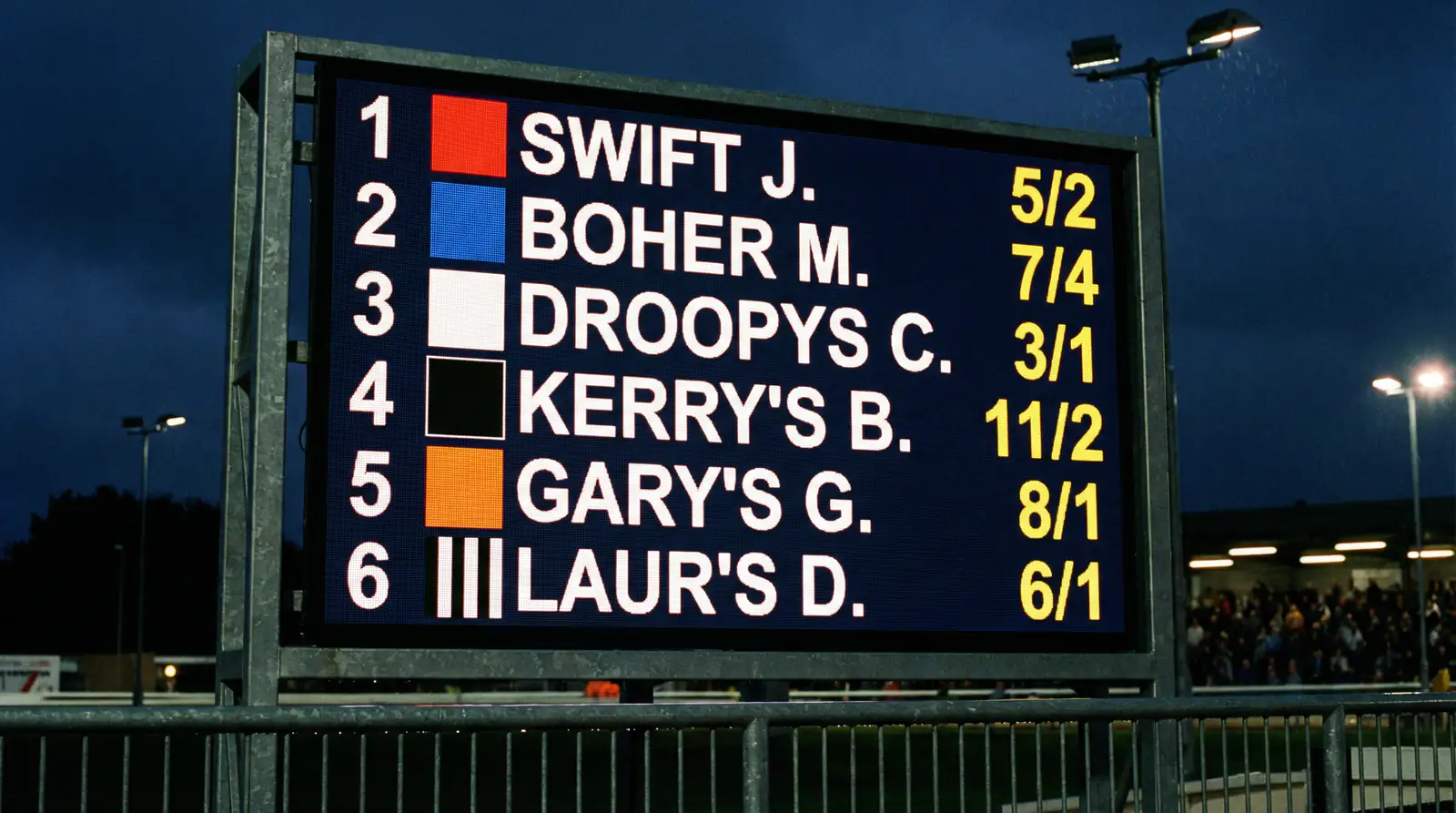
Greyhound odds in the UK are predominantly displayed in fractional format — 5/2, 7/4, 11/8 — though decimal odds are available on most online platforms. The fractional price tells you the profit relative to your stake: 5/2 means £5 profit for every £2 staked, plus the return of your original stake. For shorter prices like 4/6 or 8/13, converting to decimal format (1.67, 1.62) makes the actual return clearer.
Greyhound markets are thin and volatile — the window between early prices and SP is where value appears and vanishes.
Value, in the strict betting sense, exists when the probability implied by the odds is lower than the actual probability of the outcome. If you assess a dog as having a 30% chance of winning and the odds imply a 20% chance (roughly 4/1), the bet has positive expected value. The challenge is that six-runner fields leave less room for mispricing than a 20-horse handicap — the market is often reasonably efficient at the top end. The value tends to lurk in the middle of the market: dogs priced between 3/1 and 7/1, competitive enough to have a genuine chance but not so prominent that the market has priced them perfectly.
Starting Price, Early Price & Best Odds Guaranteed
SP is the fallback. Early price is the play. The starting price in greyhound racing is determined at the moment the traps open, based on the on-course market. It is the default price your bet settles at if you do not take a fixed price in advance. For most off-course bettors, SP is the price you get if you simply back a dog without clicking on a specific number — and in many cases, it is worse than the early price that was available minutes earlier.
Early prices are posted by bookmakers before each race, typically 10 to 15 minutes before the off. These prices represent the bookmaker's opening assessment of the race, and they are the prices that move as money comes in. Taking an early price locks in that number — if the dog drifts, you still get paid at the price you took. If the dog shortens, you still get the early price. This is the mechanism that creates the value window: the period between the early price going up and the SP being fixed.
Best Odds Guaranteed bridges the gap. BOG is a promotion offered by most major UK bookmakers on greyhound racing, though not all meetings are covered. If you take an early price and the SP turns out higher, BOG ensures you are paid at the better price. This removes the downside of taking early prices — you lock in a floor, but your payout can only go up. Checking whether your bookmaker offers BOG on greyhounds should be part of your pre-bet routine.
One nuance worth noting: BOG typically applies to win bets, not always to forecast or tricast markets, and the terms vary by bookmaker and meeting.
Five Form Angles That Actually Work at the Dogs
Forget systems. Focus on patterns. The internet is full of greyhound betting systems that promise consistent profits from mechanical rules — always back trap 1, always oppose the favourite, always bet the forecast in sprints. None of them work reliably, because greyhound racing generates too much variance for rigid systems to overcome the bookmaker's margin. What does work is pattern recognition: identifying situational advantages in the form that the market has not fully priced in.
The five angles outlined below are not a system. They are a framework — a set of form perspectives that, when applied consistently and in combination, improve the quality of your selections. None guarantees a winner in any given race. All of them, applied across enough races, tilt the probabilities in your favour by a fraction. In betting, fractions are everything.
The five angles are: early pace and first-bend position, class movement trends, track-specific form, weight changes, and sectional time comparison. The first two — early pace and class movement — get their own sections below. The remaining three are covered in detail in the cluster articles. The framework is consistent across all five: form analysis is not about finding the best dog in the race. It is about finding the dog whose actual chance exceeds the price the market is offering.
Do
- Check first-bend sectional stats for every runner before betting.
- Track recent weight changes — a dog shedding half a kilo often signals improving fitness.
- Compare sectional times across the same track, not across different venues.
- Focus on two or three meetings per session rather than spreading thin.
Don't
- Back favourites blindly — the favourite wins roughly 33% of the time in greyhound racing.
- Ignore the trap draw, especially in sprints and on tight circuits.
- Chase losses by increasing stakes after a losing run.
- Treat form from different tracks as interchangeable without adjusting for circuit differences.
Early Pace and First-Bend Position
The dog that leads at the first bend wins more often than any other statistical indicator predicts. This is the single most reliable pattern in greyhound racing, and it holds across virtually every track and distance in the UK. The reason is mechanical: in a six-dog field running around an oval circuit, the dog that reaches the first bend in front gets the rail, avoids the crowding that happens when the field bunches, and races the shortest possible distance from that point forward. Every other dog is either running wider, getting checked by traffic, or expending energy to improve position — all of which cost time.
Sectional times to the first bend capture this precisely. Most racecards now include sectional data, and where they do not, Timeform provides it. A dog posting a first-bend sectional of 4.10 seconds at Romford is reaching the bend faster than one posting 4.25, and that difference often translates into a length or more of advantage that compounds through every bend.
The trap draw feeds directly into this. A fast breaker from trap 1 has the inside rail and the shortest run to the first bend. A fast breaker from trap 6 needs to cross the field to reach the rail. Both dogs might have identical sectional times in isolation, but the trap 1 dog converts that speed into a positional advantage more reliably. A confirmed front-runner drawn in trap 1 or 2 on a tight track, with sectional times that beat the field — that is a structural edge, not a hunch.
Reading Class Movements and Trends
A dog dropping from A3 to A5 is not declining — it is being positioned. The grading system is not static. Dogs move up and down the grades based on recent results, and these movements create some of the most reliable value opportunities in greyhound betting. A dog that has been competing at A3 and struggling — finishing fourth, fifth, sixth against stronger opposition — might drop to A5 where the competition is weaker and the sectional times are slower. That dog has not suddenly become worse. It has been placed in a race where its existing ability level gives it a significant edge.
The reverse also applies, but less favourably. A dog promoted from A6 to A4 after a string of wins is stepping up. The market often remembers the recent wins without fully accounting for the class increase. These dogs frequently disappoint at their new grade, at least initially, because the pace is faster and the margins tighter. Opposing recently promoted dogs in their first run at a higher grade is a consistently profitable angle.
The smartest approach is to track class movements across several runs rather than reacting to a single shift. A dog that has dropped twice in three weeks — from A3 to A4 to A5 — is being systematically lowered to find its level. If the form at A5 shows improvement, the trajectory suggests the dog is well-placed and may continue to deliver. That combination of class position and form trend is one of the most reliable selection tools in the sport.
The UK Greyhound Racing Calendar — What to Watch
The Greyhound Derby at Towcester is the one everyone talks about — but the calendar runs deep. UK greyhound racing operates a year-round fixture list, with Category 1 and Category 2 open races distributed across the calendar from January through December. These feature events attract the best dogs in training, carry the largest prize funds, and generate the most active ante-post and on-the-day betting markets. Knowing the calendar is not just for enthusiasts — it is practical intelligence for anyone who bets on the sport.
The English Greyhound Derby, held at Towcester, is the pinnacle. The 2026 competition runs through its traditional spring-to-summer schedule — first-round heats beginning on 30 April, quarter-finals on 23 May, semi-finals on 30 May, with the final on Saturday 6 June. The knockout format reshuffles the ante-post market after every stage, giving bettors a rare opportunity to engage with greyhound racing as a multi-week narrative rather than a single-race event.
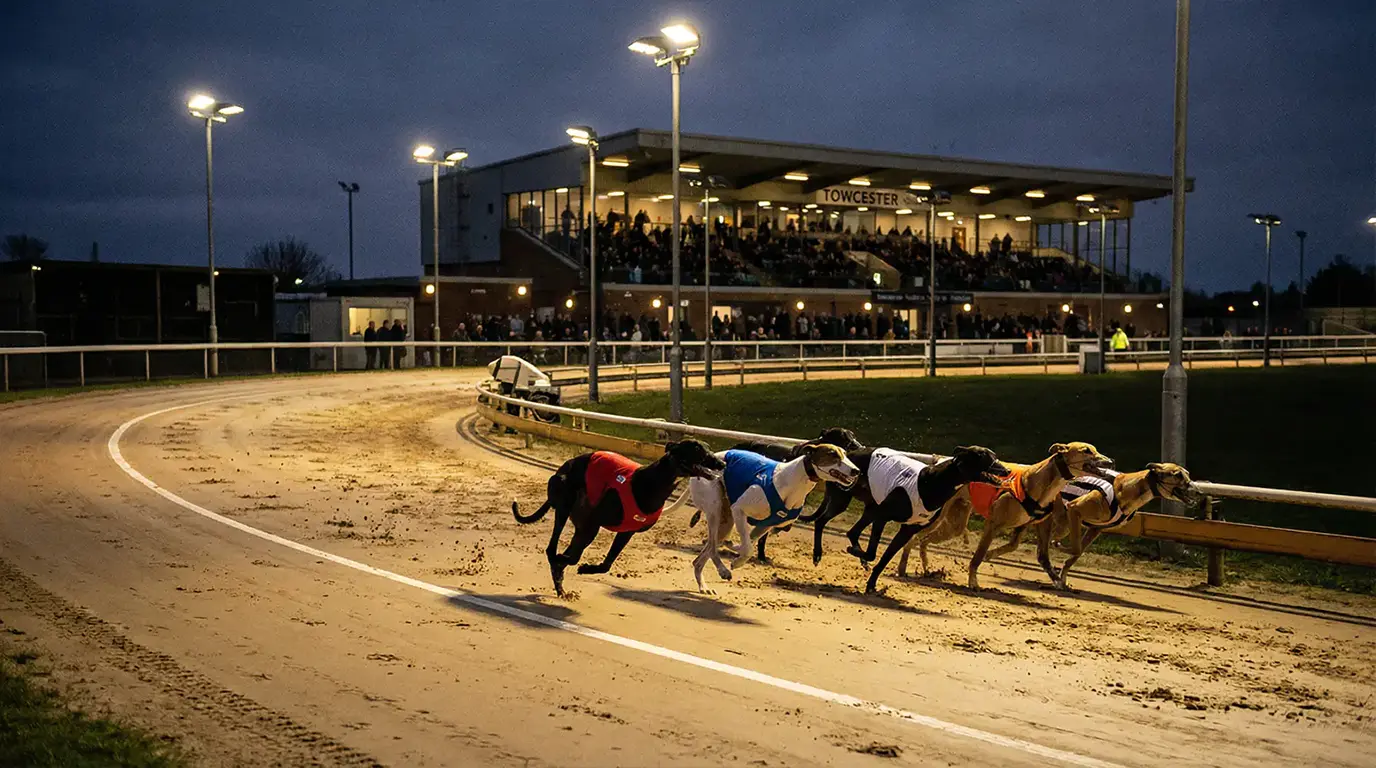
Beyond the Derby, several other fixtures anchor the calendar. The Greyhound St Leger is the stayers' championship, run over 715 metres at Dunstall Park for the 2026 season, testing stamina over a demanding trip. The Select Stakes at Nottingham is another Category 1 event. The Sussex Cup at Hove, the Cesarewitch at Central Park, and the All England Cup at Newcastle provide further flagship events through the autumn and winter months.
The GBGB publishes a full open-race calendar at gbgb.org.uk/racing/open-races, listing every Category 1 and Category 2 fixture with dates, venues, distances, and prize money. For the 2026 season, this remains the most authoritative source, and checking it periodically gives you advance notice of major betting events before the ante-post markets open.
The major events cluster in summer and autumn, but UK greyhound racing has no true off-season. BAGS meetings run throughout the winter, evening cards continue year-round at most tracks, and there are always races to bet on. The seasonal pattern is about quality concentration, not availability — the flagship events elevate the sport from its daily rhythm, but that daily rhythm never stops.
Common Questions About UK Greyhound Meetings
How many greyhound meetings are held each week in the UK, and where can I find today's schedule?
Up to 39 meetings per week run across licensed GBGB stadiums, with fixtures spread between daytime BAGS meetings and evening or weekend cards. The exact number varies by day — weekdays typically offer four to six fixtures, while Saturdays can host eight or nine. Today's schedule is listed on Timeform, Sporting Life, and At The Races racecards pages, all of which are updated daily by mid-morning. The GBGB also publishes the weekly fixture list on its official website.
What is the difference between graded races, open races, and handicap races at a greyhound meeting?
Graded races group dogs by ability class, running from A1 (the highest standard) down to A11 (the lowest), with a separate D-grade scale for sprint distances. Dogs are promoted or demoted based on recent results, so the grade reflects current form rather than career best. Open races are invitational events for higher-calibre dogs, often carrying prize money and attracting the strongest fields on the card. Handicap races use staggered start positions to equalise dogs of differing ability, giving slower dogs a head start — these require a different betting approach because raw speed matters less than the handicapper's assessment.
How do forecast and tricast bets work at greyhound meetings?
A forecast requires correctly predicting the first and second-place finishers in exact order. If you name the winner and the runner-up correctly, the bet pays out at the declared forecast dividend. A reverse forecast covers both permutations — your two selections finishing in either order — and costs twice the unit stake. A tricast extends this to three dogs: you must correctly predict first, second, and third in exact order. Combination versions of both forecasts and tricasts cover all possible orderings of your selections, increasing the stake but removing the need to call the precise finishing sequence. Minimum stakes are typically £1 for forecasts and £1 for tricasts when placed through the tote.
From the Rail — Where the Smart Money Goes Next
Greyhound betting is one of the last corners of UK sport where a punter with a notebook and a sharp eye can consistently find edges. The markets are thinner than horse racing, the fields are smaller, the data is more accessible, and the turnover cycle is faster. None of that guarantees profit — nothing in betting does — but it does mean the conditions for finding value are better than in most other sports betting markets.
The direction of travel points towards increased data availability and broadcast access. More tracks publish detailed sectional times, more meetings stream live through bookmaker platforms, and the GBGB continues to standardise how race data is recorded. For bettors who base their approach on form analysis rather than gut instinct, this is a positive trend — more data means more opportunities to identify mispriced runners.
The meeting structure itself remains the engine of the sport. Whether you are studying a Monday BAGS card at Sunderland or sweating the Greyhound Derby final at Towcester, the mechanics are the same. Six traps, a hare, a stopwatch, and a form book. The edges are in the details: the class drop the market has not noticed, the sectional time that reveals hidden pace, the trap draw that gives one dog an advantage the odds do not reflect.
That is where the smart money goes. Not into systems, not into accumulators, and definitely not into chasing last night's losses. Into preparation, discipline, and a willingness to skip races where no clear edge exists. The best greyhound bettors do not bet on every race — they engage where their analysis provides a reason, and sit out the rest. In a sport that offers 30 or more races every evening, the ability to walk away from 25 of them is the most underrated skill of all.
