Greyhound Sectional Times Explained
Best Greyhound Betting Sites – Bet on Greyhounds in 2026
Loading...
Sectional Times — The Hidden Layer of Greyhound Form
Most bettors look at the finishing time and move on. The dog ran 29.45 seconds over 480 metres — fast enough, or not fast enough, depending on the track standard. But the finishing time is a summary. It tells you what happened overall without telling you how it happened. Sectional times break the race into parts, and those parts contain information that the overall time conceals.
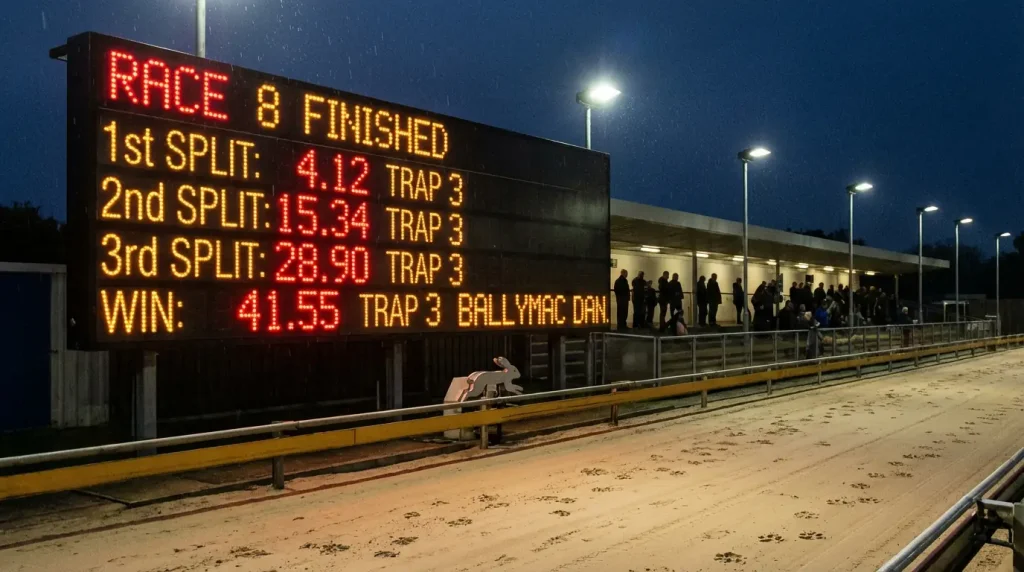
A sectional time measures the dog’s speed over a segment of the race — typically from the traps to the first timing point, from the first bend to the second, and through the run-in to the finish. Different tracks measure different splits, but the principle is universal: the race is not one event, it is a sequence of events, and the dog that ran 29.45 might have done so by leading from the traps and hanging on, or by trailing at halfway and producing a devastating closing burst. These are two entirely different performances that happen to produce the same headline number.
For the bettor willing to dig beneath the surface, sectional times offer a competitive edge. They reveal which dogs have genuine early pace and which merely benefit from favourable draws. They expose dogs whose finishing times are flattered by slow early fractions, and they identify improving dogs whose sectionals show a trajectory even when the overall time stays flat. This is form data that most recreational punters never look at, and that asymmetry is precisely why it has value.
Sectional analysis is not complicated. It requires access to the data, a basic understanding of what the numbers mean, and the discipline to incorporate them into your existing form-reading process. The payoff — a clearer, more granular picture of each dog’s ability — is worth the effort many times over.
What the Split Data Actually Measures
The most common sectional time in UK greyhound racing is the time from the traps to the first timing beam, usually positioned at or near the first bend. This is recorded as a run-up time and tells you how quickly the dog broke from the boxes and reached the first timing point. At a standard four-bend track over 480 metres, this initial section covers roughly the first 90 to 120 metres of the race.
The run-up time is the most valuable single sectional for betting purposes because it measures the variable that most strongly correlates with winning: early pace. Dogs that reach the first bend ahead of the field have a documented statistical advantage. They have the shortest route to the rail, they avoid traffic, and they carry momentum into the bends where slower dogs lose ground through crowding and checking. A consistently fast run-up time — regardless of where the dog finishes — identifies a runner with genuine early speed, and that information feeds directly into trap draw analysis and race-shape prediction.
The second common split covers the middle section of the race, from the first timing point to a second beam positioned further around the circuit. This middle split reflects the dog’s ability to maintain speed through the bends, where aerobic capacity and running efficiency matter more than raw acceleration. Dogs that maintain their speed through the middle section are typically fitter and more mechanically sound than those who decelerate sharply after the initial burst.
The final section — the run-in — measures speed from the last timing point to the finish line. This is where closers earn their money. A dog with a slow run-up time but a fast finishing section is a closer: it runs from behind, picks off tiring leaders in the straight, and finishes strongly. The run-in split identifies these dogs in a way that the overall finishing time cannot, because a fast run-in masked by a slow start produces a mediocre overall time that hides the dog’s genuine finishing ability.
Not all tracks publish all sectionals, and the timing infrastructure varies. Some tracks record only the run-up time and the overall finishing time. Others capture multiple split points and provide a fuller picture of the race dynamics. Timeform’s greyhound section and some specialist data providers break down these splits in their form data, though you may need to look beyond the standard racecard view to find them.
Using Sectional Times to Identify Improving Dogs
An improving dog does not always show improvement in its overall finishing time. Track conditions, race pace, interference at the bends, and the quality of opposition all affect the headline number. But the sectionals can reveal improvement that the overall time obscures, and this is one of the most profitable applications of split data in greyhound betting.
The pattern to look for is a dog whose run-up time is getting faster across its last three or four races, even if the finishing time has stayed flat or even increased slightly. A quicker run-up means the dog is breaking more sharply, reaching the first bend earlier, and finding a better position in the race. If that improvement in early pace has not yet translated into a finishing-time improvement — perhaps because the dog encountered trouble at a bend or faced a strong front-runner — it may be a race or two away from a breakthrough performance that the overall time alone would not predict.
Another indicator is a dog whose finishing section is getting faster while its run-up time remains consistent. This suggests improving fitness or stamina — the dog is maintaining its speed deeper into the race, finishing more strongly, and closing ground on the leaders in the final straight. If this pattern coincides with a grade where the dog has not yet won, it may be on the verge of taking the step up that a straight form reading would not anticipate.
The reverse pattern is equally useful for identifying dogs to oppose. A runner whose sectionals are deteriorating — slower run-up times, longer middle splits, weaker finishes — may be declining in fitness or carrying a minor issue that has not yet produced a dramatic form collapse but is visible in the underlying data. The overall finishing time might still be respectable because the dog has been racing in lower grades against weaker opposition, masking the decline. The sectionals strip away that mask.
Sectional trends matter more than individual readings. A single fast or slow split can be an anomaly — the dog slipped at the start, or the track was running fast due to weather conditions. Three or four readings in the same direction constitute a trend, and trends are what you bet on.
Where to Find Reliable Sectional Data
Timeform is the most accessible source of sectional data for UK greyhound racing. Their greyhound racecard and form pages include run-up times and, for many tracks, additional sectional splits. The data is presented alongside the standard form information, making it straightforward to incorporate into your analysis without needing to switch between multiple sources.
The GBGB results database holds official timing data for all regulated meetings, though the presentation is less user-friendly for quick form analysis than the commercial providers. Racing Post’s greyhound section also carries sectional data for covered meetings, and At The Races includes timing information in its form guides for races broadcast through its platform.
Some bettors build their own sectional databases by recording splits from races they watch live. This is time-consuming but produces a personalised resource that is tailored to the tracks and grades you bet on. A spreadsheet tracking run-up times, middle splits, and finishing sections for dogs at your regular track gives you a depth of information that no published source can match for your specific betting context.
The quality and completeness of sectional data varies by track. Larger venues with modern timing equipment tend to provide more detailed split data than smaller tracks. BAGS meetings, which run at a high volume, generally produce consistent timing data because the SIS broadcast infrastructure includes standardised timing systems. Evening and premier meetings at major venues like Romford, Nottingham, and Monmore also provide reliable sectionals.
One caveat on data quality: timing beams can occasionally malfunction, producing anomalous readings that do not reflect the dog’s actual performance. Cross-referencing a suspicious split against the race video — available through bookmaker streams and SIS archives — is the simplest way to verify whether a reading is genuine or an equipment error.
The Clock Doesn’t Lie — Your Interpretation Might
Sectional times are objective data. The timing beam records what it records, and the numbers do not carry bias or opinion. But the interpretation of those numbers is where subjectivity enters, and where mistakes are made.
The most common error is comparing sectional times across different tracks as though they were interchangeable. A run-up time of 4.80 seconds at Romford and a run-up time of 4.80 seconds at Towcester do not represent the same level of early pace, because the distance from the traps to the first timing beam differs between tracks, as do the track surface, the gradient, and the prevailing conditions. Sectional comparisons are meaningful within a single track, across races at that track, but not between tracks without careful adjustment.
Another error is overweighting a single exceptional sectional reading. A dog that records a blazing run-up time in one race but reverts to its normal pace in the next two was probably benefiting from a fast-running track, a fortuitous break, or an unusually slow field rather than demonstrating a genuine improvement in ability. As with all form data, the pattern across multiple races is the reliable signal; the single-race outlier is noise.
Track conditions affect sectionals significantly. A wet track runs slower. A dry, fast track produces quicker splits across the board. Before comparing a dog’s latest sectional to its previous runs, check whether the conditions were comparable. A run-up time that looks slow in isolation might actually represent strong performance on a rain-affected surface, and vice versa.
Sectional times are a tool, not an oracle. They add resolution to your form picture — turning a blurry image into a sharper one — but they do not replace the other elements of race analysis: the draw, the grade, the trainer’s intent, the dog’s physical condition. Use them as one input among several. Weight them appropriately. And remember that the clock measures what happened in the past. Your job is to predict what happens next, and the clock can only help with that if you interpret it honestly and in context.