Greyhound Puppy Races and Puppy Derbies
Best Greyhound Betting Sites – Bet on Greyhounds in 2026
Loading...
Puppy Races — How Young Dogs Enter the Sport
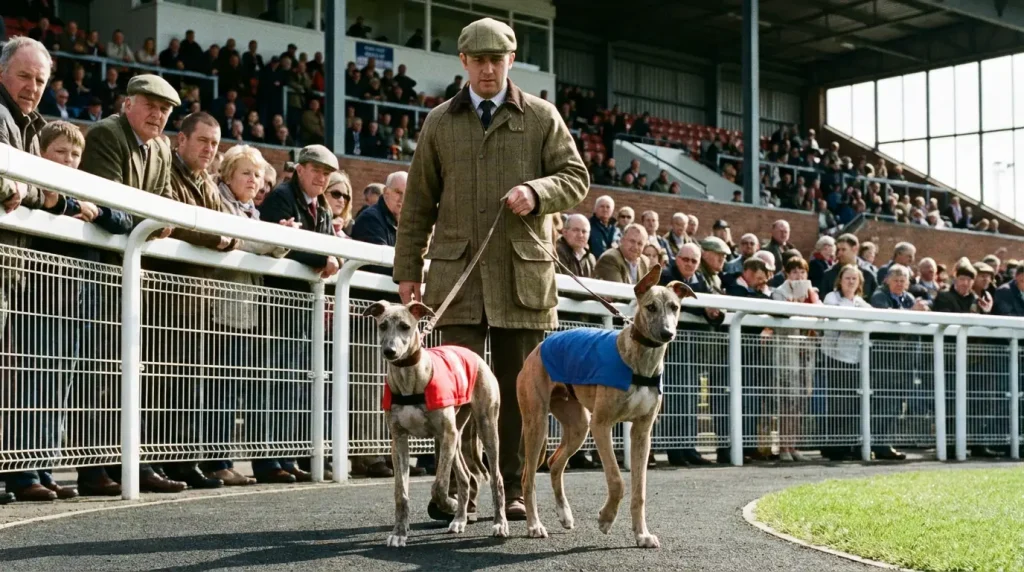
Every greyhound that races at a UK track started the same way: as a puppy with raw speed and no experience. The transition from kennel to competitive racing is a structured process that takes months, involves multiple stages of assessment, and produces the athletes that populate the racecards. Puppy races sit at the beginning of that pathway, and they serve a dual purpose — they introduce young dogs to the racing environment, and they provide the first competitive data on which trainers, owners, and bettors begin to form their assessments of a dog’s potential.
The term “puppy” in greyhound racing refers to dogs under a specific age — typically under two years old at the start of the calendar year in which the puppy competition takes place, though the exact age cutoff varies by event. These are not puppies in the domestic sense. They are adolescent athletes: physically mature enough to race, strong enough to handle the demands of the track, but inexperienced in the tactical realities of competitive six-dog racing. Their form lines are short, their grading history is thin, and their future trajectory is uncertain. That uncertainty is both the challenge and the appeal of puppy racing from a betting perspective.
Puppy events are staged throughout the UK greyhound calendar, from informal trial stakes at local tracks to the major puppy derbies that attract the best young dogs in the country. The quality spans the full range — from modest novice events where dogs are still finding their feet to Category 1 puppy classics where the future stars of the sport are identified. Understanding the structure and significance of puppy racing opens a window on the sport’s developmental pipeline and, for the patient bettor, a source of value that the broader market often overlooks.
Age Rules, Schooling Trials and Early-Career Development
A greyhound must be at least fifteen months old to run in any race or initial trial at a GBGB-licensed track. Before reaching that age, young dogs may undergo schooling trials — assessed runs at the racing manager’s discretion, designed to determine whether the greyhound will properly chase the artificial hare. Schooling is the process by which a young dog is introduced to the racing environment — the traps, the mechanical hare, the track surface, the experience of running alongside other dogs. Schooling trials are not competitive races. They are assessed runs, observed by the racing manager, designed to confirm that the dog is physically and temperamentally ready to compete.
During schooling, the dog typically completes a series of solo runs and then progresses to trials alongside one or two other dogs, building towards a full six-dog trial. The racing manager evaluates the dog’s trap behaviour, its running line through the bends, its response to the hare, and its overall demeanour. A dog that breaks cleanly, runs a true line, and shows no signs of distress or aggression is cleared for competitive racing. A dog that behaves erratically, fails to pursue the hare, or displays dangerous running habits may be required to complete additional schooling before being granted a racing licence.
Once cleared, the dog is graded — assigned an initial race class based on its trial times — and entered into competitive races. The first few competitive runs are critical: the dog is learning to race in a pack, dealing with the physical contact and tactical jostling of six-dog fields, and establishing the form profile that will follow it through its career. Early form is volatile. A dog that finishes last in its first two races may be struggling with the transition from trials to competition rather than lacking ability. Equally, a dog that wins its first race may have benefited from a weak field or a kind draw rather than possessing exceptional talent.
Trainers manage the early-career development of their puppies carefully. Some trainers introduce young dogs gradually, spacing their early races to allow recovery and learning between runs. Others adopt a more intensive approach, running puppies frequently to accelerate their adaptation to competitive racing. The approach depends on the individual dog’s temperament, physical maturity, and the trainer’s assessment of its long-term potential. A puppy being prepared for a major event will follow a targeted programme designed to peak at the right time, while a puppy being developed for a regular graded career may follow a more organic path.
Major Puppy Derbies and Stakes Events
The headline puppy events on the UK greyhound calendar are the puppy derbies — competitions restricted to young dogs that serve as the first major tests of each generation. These events carry significant prize money, prestige, and attention from the racing and betting communities.
The most prominent puppy event is the Puppy Derby, which has been contested at various venues over the years and attracts the best young dogs from kennels across the country. The format mirrors the senior derby structure: multiple rounds of heats, with qualifiers progressing through quarter-finals and semi-finals to a six-dog final. The competition unfolds over several weeks, and each round provides fresh form data on the runners — data that is particularly valuable because many of the dogs are still developing and their performances can change markedly from one round to the next.
Other significant puppy events include the Puppy Cup, the Puppy Oaks for female dogs, and various regional puppy championships that serve as stepping stones to the national competitions. These events vary in their entry requirements, distance, and prize levels, but they share the common thread of featuring young dogs with limited form histories and uncertain ceilings.
Puppy classics also serve a scouting function within the sport. Trainers use them to test their promising young dogs against the best of their age group, and the results inform decisions about which dogs will be campaigned at the highest level and which will settle into regular graded racing. A strong run in a puppy derby does not guarantee future greatness, but it identifies the dogs with the combination of speed, temperament, and competitive instinct that the major open races demand. Owners and trainers who identify these dogs early — and bettors who follow them — gain a head start on the market as the dogs progress through the grading system.
Betting on Puppies — What Early Form Can and Can’t Tell You
Betting on puppy races requires a different analytical framework from betting on established graded runners. The form book is thinner, the sample sizes are smaller, and the dogs are changing — physically and behaviourally — between runs. A puppy’s form from three races ago may be less representative of its current ability than the equivalent data for a mature dog, because the puppy has been developing, learning, and adapting in the interim.
What early form can tell you is whether the dog has genuine early pace, whether it handles the bends cleanly, and whether it is improving from run to run. These are structural attributes — they relate to the dog’s physical capability and its adaptation to racing — and they tend to be reliable indicators even in small samples. A puppy that has shown fast run-up times in three consecutive races has genuine early speed. A puppy that has improved its finishing position in each of its last four races is on an upward trajectory. These patterns are meaningful and actionable.
What early form cannot tell you is where the dog’s ceiling lies. A puppy that dominates A8 races may be a future A3 dog or it may plateau at A6. The early form does not contain enough information to distinguish between these outcomes, because the opposition at A8 is not a reliable benchmark for how the dog will perform against stronger fields. This ceiling uncertainty is the primary risk of backing puppies — the market may price a dog as though its improvement will continue indefinitely, when in reality it may be approaching its natural level.
Trial form and schooling times provide additional context that is not always reflected in the racecard. Trainers and insiders pay close attention to trial performances, and a puppy that has trialled significantly faster than its race times suggest may be capable of a step up that the form figures alone do not predict. This information is harder to access for the casual bettor, but following trainers with strong puppy development records — and trusting their placement decisions — is a practical way to capture some of that inside-track value.
The bookmakers price puppy races with wider margins than mature graded races, reflecting the higher uncertainty. This means there is more room for the informed bettor to find value — the gaps between the market’s assessment and the dog’s true chance are larger because the market has less data to work with. But the wider margins also mean that uninformed bets are more expensive. Puppy races reward the bettor who does the homework and penalise the one who does not.
Every Champion Was Once a Puppy on Trial Day
The greyhounds that win the Derby, the St Leger, and the major opens all passed through the same developmental pathway: schooling trials, early graded races, puppy competitions, and the gradual refinement of their racing careers. The names that dominate the sport’s history were once unknown puppies being assessed by a racing manager on a quiet Tuesday afternoon, running their first tentative laps of an unfamiliar track.
For the bettor, puppy racing offers something that mature graded racing does not: the chance to spot a future star before the market has identified it. This is speculative, uncertain, and more often wrong than right. But when it works — when a puppy you followed from its first novice race progresses through the grades and into the big events — the satisfaction extends beyond the betting slip. You backed the dog when its story was just beginning, and that is a different kind of reward.
Puppy racing is where the sport renews itself. Every season, a new cohort of young dogs enters the system, and the form book starts filling with fresh names and emerging patterns. Watching that process unfold — race by race, trial by trial — is one of the most engaging aspects of following UK greyhound racing. The betting angles are there for those who look. The stories are there for everyone.