Greyhound Forecast Bet Explained
Best Greyhound Betting Sites – Bet on Greyhounds in 2026
Loading...
Forecast Bets — Precision Pays
The win bet is the foundation of greyhound betting. The forecast is where the craft begins. A forecast bet asks you to predict not just the winner of a race, but the exact finishing order of the first two dogs. It is harder than a straight win bet, obviously, and the difficulty is reflected in the returns. Where a win bet on a 3/1 shot yields a modest profit, a correctly predicted forecast on the same race might pay ten, twenty, or even fifty times your stake depending on the combination of dogs involved.
Forecast betting is the natural next step for anyone who has progressed beyond simply picking the dog they fancy to win. It requires a deeper reading of the racecard — not just identifying the likely winner, but assessing the whole field to determine which dog is most likely to finish second. That second element is what makes forecasts both more rewarding and more intellectually demanding than single bets. You need an opinion on the entire race, not just its winner.
In UK greyhound racing, forecasts are available through the tote at the track and through fixed-odds bookmakers online and in shops. The mechanics differ slightly depending on which route you take, and we will cover those differences, but the core principle is the same: name two dogs, specify the order, and get paid if you are right.
The appeal of forecasts is that they offer value in situations where the win market does not. A race with a strong favourite at 4/6 might seem unappealing for a straight win bet — the reward does not justify the risk. But if you can pair that favourite with a less obvious second-place finisher, the forecast dividend can turn a predictable race into a profitable one. This is where greyhound knowledge starts paying its way.
Straight Forecast — First and Second in Order
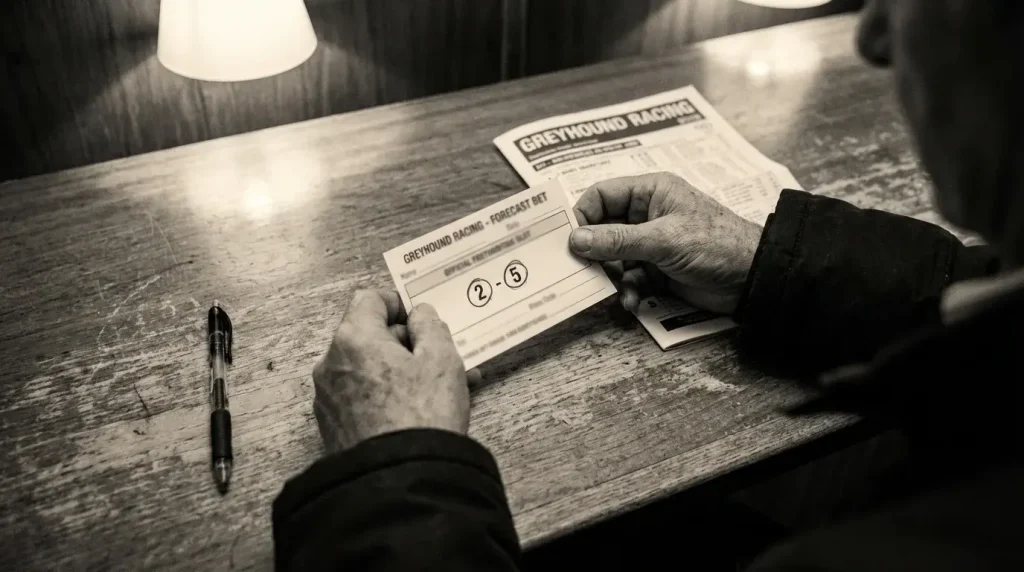
A straight forecast is the purest form of the bet: you select one dog to finish first and another to finish second, in precisely that order. There is no ambiguity, no safety net. If your two dogs finish first and second but in the wrong order, you lose. If your first selection wins but a different dog takes second, you lose. The bet pays out only on the exact combination you specified.
At the tote, the straight forecast dividend is determined by the pool. All forecast stakes for the race are combined, the track takes its percentage, and the remainder is divided among the winning combinations. Because the pool is shared, the payout is not known until after the race. Tote forecast dividends are declared per unit stake, typically per £1, and they can vary enormously. A favourite-second favourite combination might pay £5 to £15. A combination involving two outsiders might return £100 or more.
With fixed-odds bookmakers, some operators offer forecast odds in advance, calculated from the individual prices of each dog. The formula is proprietary to each bookmaker but generally based on multiplying the implied probabilities and adjusting for margin. Other bookmakers settle forecasts at the Computer Straight Forecast price, which is an industry-standard calculation derived from the starting prices of the first two finishers. The CSF is published after the race and tends to be broadly similar to the tote dividend, though not identical.
The minimum stake for a straight forecast is typically £1 at the tote and varies by bookmaker online, though many accept forecasts from as little as 10p. The lower minimum stakes online make forecasts accessible even to bettors with modest bankrolls, and they allow you to experiment with combinations without committing significant money.
One tactical consideration that experienced bettors use: the straight forecast is most valuable in races where you have a strong view on the winner but the second-place market is open. If you believe trap 4 will win but traps 1, 3, and 6 all have a realistic chance of finishing second, you might place three separate straight forecasts — 4 with 1, 4 with 3, and 4 with 6 — to cover the likely second-place finishers. This costs three times the single forecast stake but gives you three chances to collect, and the dividend on any of them should comfortably exceed the total outlay if your selection of the winner is correct.
Reverse and Combination Forecasts
The reverse forecast removes the order requirement. You select two dogs to finish first and second, but either one can take either position. If your two selections fill the first two places in any order, you collect. A reverse forecast is technically two bets — one for each possible order — so a £1 reverse forecast costs £2 in total.
The payout on a reverse forecast is typically lower than a straight forecast for the same combination, because you are covering two outcomes instead of one. The trade-off is obvious: you give up some of the potential return in exchange for a wider margin of error. For races where you are confident that two dogs will dominate but uncertain which will finish ahead of the other, the reverse forecast is the logical structure.
The combination forecast extends this principle to three or more dogs. You select three dogs, and the bet covers all possible first-and-second combinations among them. With three selections, there are six possible straight forecasts, so a £1 combination forecast costs £6. With four selections, the permutations rise to twelve, and the cost rises accordingly. The combination forecast is expensive but powerful when a race looks genuinely open among a small group of contenders.
Here is where discipline matters. The combination forecast can feel like a safety blanket — select three or four dogs and surely two of them will fill the first two places. But the cost of coverage erodes the profit margin quickly. A £1 combination forecast on three dogs costs £6. If the resulting dividend is £8, your net profit is £2 — a 33% return on outlay. The same result from a correctly placed £1 straight forecast would have netted you £7 profit. The combination approach sacrifices precision for coverage, and in a sport where the dividends are not guaranteed to be large, that sacrifice can eat into your edge.
The practical rule is to use combination forecasts sparingly and only in races where the field genuinely offers multiple credible contenders for the first two places. In races where one dog stands out as the likely winner, a set of straight forecasts keyed on that dog is almost always more efficient than a blanket combination.
When to Use a Forecast vs a Win Bet
The decision between a forecast and a win bet should be driven by the race conditions, not by habit or by a desire for bigger payouts. Each bet type has a purpose, and using the wrong tool for the situation costs money over time.
Use a win bet when you have identified one dog that you believe has a clear advantage over the field and the price offers value. The win bet is clean, simple, and efficient. It does not require you to have an opinion on the second-place finisher, and it allows you to concentrate your stake on a single outcome. If the race has a strong favourite that you trust at a reasonable price, the win bet is the right instrument.
Use a forecast when the win price does not offer value but you have a strong view on how the race will unfold. The classic example is the short-priced favourite. If a dog is 4/7 to win and you agree it will probably win, there is little profit in backing it outright. But if you pair it with a less fancied second dog at a longer price, the forecast dividend might return five or six times your stake — a far better reward for essentially the same assessment of the race. The forecast unlocks value in situations where the win market has compressed the price to the point where the return does not compensate for the risk.
Forecasts also make sense in races where the form points to two dogs dominating but you cannot confidently separate them. Rather than backing one to win and hoping you chose correctly, a reverse forecast on the pair covers both outcomes. Your total stake is higher, but your probability of collecting is substantially better than a single win bet on either dog.
Where forecasts do not make sense is in genuinely open races with six evenly matched dogs and no clear form standout. In that scenario, you would need to cover so many combinations that the cost of coverage exceeds the likely return. Some races are simply not forecastable with any confidence, and the smart response is to bet small on a win selection or to pass the race entirely.
The other scenario to avoid is the speculative long-shot forecast — two outsiders thrown together in the hope of a big payout. This approach has the expected value of a lottery ticket and should be treated the same way: entertainment money, not investment capital.
The Forecast Is a Scalpel — Use It Like One
Precision pays in greyhound racing, and the forecast is the bet type that rewards precision most directly. It asks more of your analysis, demands a broader understanding of the field, and pays you accordingly when you get it right. The key is to use it as a tool for specific situations, not as a default bet type on every race.
The best forecast bettors share a common trait: they are willing to pass races that do not suit the bet type. They wait for the card where a strong favourite faces a race with one clear second dog, or where form analysis points unmistakably to a pair of dogs that will pull clear of the rest. They do not force forecasts onto races that call for a different approach.
Build your forecast betting around races where your analysis gives you an edge on the second-place finisher, not just the winner. That is the distinction. Anyone can identify the favourite. The bettor who can tell you which dog will finish behind the favourite — and explain why — is the one who makes forecasts work as a consistent, profitable part of their greyhound betting.