
Greyhound Betting Exchanges vs Bookmakers
 Available in US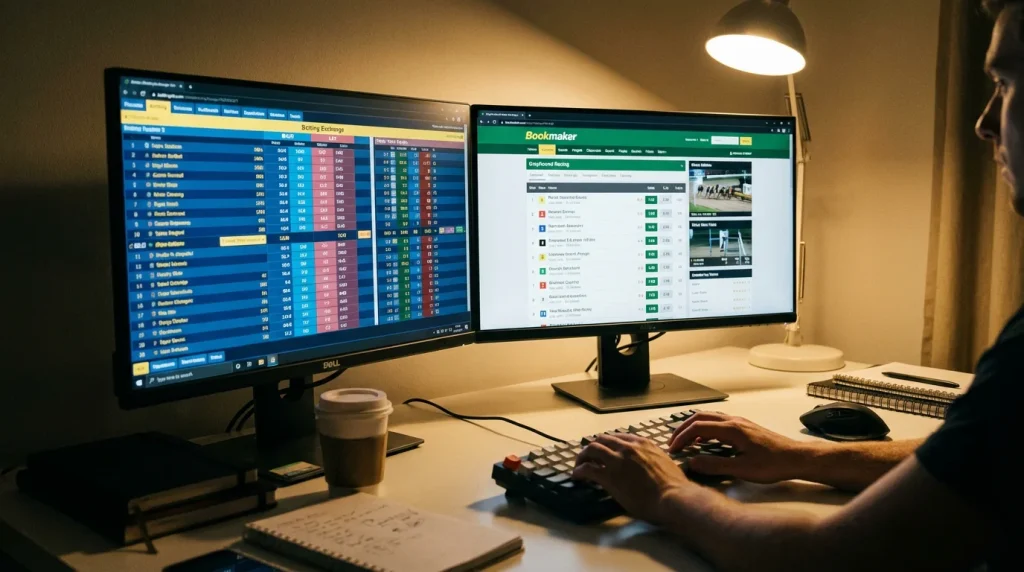
Exchange vs Bookmaker — Two Different Markets
When you place a greyhound bet with a bookmaker, you are betting against the bookmaker. The bookmaker sets the odds, accepts your stake, and pays you if you win. The bookmaker’s profit comes from the overround built into the odds — the margin that ensures the total implied probabilities exceed 100%, guaranteeing the bookmaker a mathematical edge over the long run.
When you place a bet on a betting exchange, you are betting against other bettors. The exchange is a marketplace where individuals offer and accept odds on greyhound races. One person backs a dog to win; another person lays that dog — accepting the bet that it will not win. The exchange facilitates the transaction, matches the two sides, and takes a commission on the winner’s profit. The exchange itself has no stake in the outcome of the race. Its revenue comes from the commission, not from the betting result.
This structural difference changes the dynamics of pricing, market depth, and the betting experience itself. The bookmaker operates a take-it-or-leave-it model: here are the odds, place your bet or move on. The exchange operates an auction model: propose your own odds, and if someone on the other side accepts them, the bet is matched. Both models have strengths and weaknesses for the greyhound bettor, and understanding which to use in which circumstances gives you flexibility that neither model provides alone.
How Greyhound Exchange Markets Work
The dominant betting exchange in the UK is Betfair, which hosts markets on the vast majority of UK greyhound meetings. The exchange displays two sets of prices for each runner: the back price (the best available odds for backing the dog to win) and the lay price (the best available odds for laying the dog — betting that it will not win). The difference between the back and lay prices is the spread, and it represents the exchange equivalent of the bookmaker’s margin.
To place a back bet on the exchange, you select the runner and the back price, enter your stake, and submit the bet. If sufficient lay money is available at that price, the bet is matched immediately. If not, the bet sits in the market as an unmatched offer until either someone accepts it or you cancel it. The matched bet settles after the race: if your dog wins, you receive your profit minus the exchange’s commission; if it loses, you lose your stake.
Laying is the exchange’s unique feature. When you lay a dog, you are accepting someone else’s back bet — you are betting that the dog will not win. If the dog loses, you win the backer’s stake. If the dog wins, you pay out the backer’s winnings. Laying requires a higher balance in your account because the potential liability is larger than the potential profit. For example, laying a dog at 4/1 for a £10 stake means you risk £40 (the backer’s potential winnings) to win £10 (the backer’s stake). Laying is a powerful tool for bettors who have identified a dog they believe is overpriced but do not want to back a specific alternative.
The exchange also supports in-play betting on greyhound races — placing or adjusting bets after the traps have opened, while the race is being run. In-play exchange markets for greyhounds are fast-moving and volatile, with prices swinging dramatically as the dogs change position through the bends. In-play exchange betting requires rapid decision-making and a reliable streaming connection to the race. It is not for beginners, but it offers opportunities for experienced bettors who can process visual information and market data simultaneously.
Liquidity, Commission and Market Depth Issues
The single most significant limitation of exchange betting on greyhounds is liquidity. Liquidity refers to the amount of money available in the market — how much can be matched at the displayed prices. A deep, liquid market allows large bets to be placed at the displayed price without moving the odds. A shallow, illiquid market cannot absorb large bets, and attempting to place them either partially matches the bet or moves the price against you.
Greyhound exchange markets are significantly less liquid than horse racing exchange markets. The reasons are structural: greyhound racing attracts lower overall betting volumes, the rapid-fire meeting schedule spreads the available liquidity across many simultaneous races, and the exchange user base for greyhounds is smaller than for horse racing. On a typical BAGS meeting, the exchange might show only a few hundred pounds available at the best back price on the favourite, compared to thousands or tens of thousands on a horse race at the same time of day.
Low liquidity has practical consequences. Large bets may not be fully matched at the requested price, leaving you with a partially filled order and a need to accept worse odds for the remainder. The back-lay spread — the gap between the best back and best lay prices — tends to be wider in greyhound markets than in horse racing markets, which increases the effective cost of trading. And the prices displayed on the exchange may not be available by the time you attempt to place your bet, because a single opposing bet can consume the available liquidity at that price.
Exchange commission is typically 5% on net market profits, though this varies by user and by exchange. The commission applies only to winning bets — if you lose, no commission is charged. Over a season, the commission is a meaningful cost that should be factored into your comparative analysis of exchange versus bookmaker returns. On a £100 profit from a winning exchange bet, £5 goes to the exchange. The equivalent bet with a bookmaker at the same odds would return the full profit, but the bookmaker’s odds may have been less generous to begin with because of the overround.
When to Use Each — A Practical Decision Framework
The choice between exchange and bookmaker for greyhound betting is not ideological. It is practical, and the right answer varies by situation. A simple framework based on the specific circumstances of each bet produces better results than a blanket preference for one platform.
Use the bookmaker when you want certainty of price and immediate execution. The bookmaker’s odds are available now, at the displayed price, for stakes within the advertised limits. There is no partial matching, no waiting for a counterparty, and no risk of the price moving between your decision and your bet being accepted. For most standard greyhound bets — a £5 to £20 win bet on a BAGS race, an each-way on an evening meeting — the bookmaker provides a frictionless experience that the exchange cannot always match.
Use the exchange when the exchange price is noticeably better than the bookmaker’s price. This happens most often with outsiders and in markets where the bookmaker’s overround is wide. The exchange, with no built-in overround, often displays back prices that are more generous than the equivalent bookmaker odds on less fancied runners. If the exchange shows 8/1 on a dog that the bookmaker offers at 6/1, and the exchange has sufficient liquidity to match your stake, the exchange is the clear choice.
Use the exchange when you want to lay. The bookmaker does not offer laying — you can only back dogs to win, not bet against them. The exchange gives you this additional dimension, which is useful when your analysis concludes that a specific dog is overpriced but you do not have a strong alternative selection. Laying the vulnerable favourite at a short price is a legitimate strategy that the exchange enables and the bookmaker does not.
Use the bookmaker when best odds guaranteed applies. BOG means you receive the higher of your early price and the starting price, which is a free enhancement that the exchange does not offer. If you are backing a dog early and expect the price to drift, the bookmaker with BOG gives you upside protection that the exchange cannot provide. The combination of BOG and a competitive early price often makes the bookmaker superior to the exchange for early-price backing, even when the exchange’s raw back price is marginally better.
Use both when the bet warrants it. For significant bets — higher stakes, strong-conviction selections, major events — checking both the bookmaker price and the exchange price before placing your bet is a two-minute exercise that can yield meaningfully better returns. The platform that offers the best effective price, accounting for BOG, commission, and liquidity, is the platform you should use for that specific bet.
Choose Your Arena Before You Choose Your Dog
The decision of where to bet is a decision about the terms on which you bet. The bookmaker offers simplicity, certainty, and features like BOG that add value to specific betting styles. The exchange offers flexibility, the ability to lay, and sometimes better raw prices on selections where the bookmaker’s margin is wide. Neither is universally superior, and the bettor who uses both — switching between them based on the specific circumstances of each race and each bet — is operating with a wider range of options than the bettor who is loyal to one platform.
Most greyhound bettors will find that the bookmaker is their primary platform for the majority of bets, with the exchange serving as a specialist tool for specific situations: laying vulnerable favourites, backing outsiders at superior odds, or trading in-play during major events. This allocation reflects the practical reality of the greyhound exchange market — its liquidity limitations make it less suitable for everyday betting than the bookmaker, but its unique features make it indispensable for certain types of wager.
Learn both. Maintain accounts on both. And on every bet, take the three seconds to compare the price before committing your money. The arena matters as much as the selection, and the bettor who chooses both wisely is the one who extracts the most value from the greyhound betting market.
Find more strategy guides at greyhoundmeetings.
Also read our how to bet on greyhounds online UK.
