
Greyhound Jackpot and Pick 6 Bets
 Available in US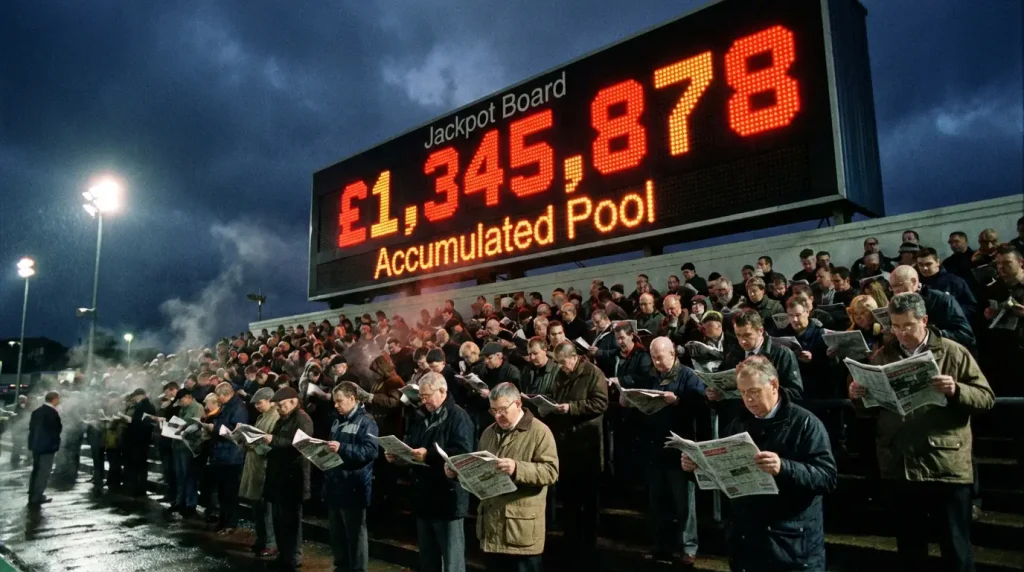
Jackpot and Pick 6 — The Big Pool Bets
The jackpot and Pick 6 are the lottery tickets of greyhound betting — multi-race pool bets that require you to select the winner of several consecutive races on a single card. Get them all right, and the payout can be substantial. Get one wrong, and the bet is dead. There is no partial return, no consolation prize for five out of six, and no way to hedge your position once the first race has been run. The appeal is obvious: a small stake can produce a life-changing return. The reality is equally obvious: the chances of landing the full sequence are extremely slim.
These bets operate as pools, not fixed-odds markets. All the money staked on the jackpot or Pick 6 goes into a single pool, from which the operator takes a deduction and the remainder is divided among the winning tickets. If nobody picks all the winners, the pool rolls over to the next qualifying meeting, growing larger until it is eventually claimed. Rolled-over pools can accumulate to significant sums, creating the headline-grabbing dividends that attract casual bettors and give these bets their particular excitement.
The jackpot typically covers six nominated races on a card. The Pick 6 is a similar format, sometimes using a different selection of races or operating under slightly different rules depending on the tote operator and the track. The core principle is identical: select the winner of every leg, or go home empty-handed. The simplicity of the premise and the magnitude of the potential reward make these bets a fixture of greyhound racing’s betting landscape, even among bettors who would never normally consider pool wagering.
How Jackpot Pools Accumulate and Pay Out
The jackpot pool begins with the aggregate of all stakes placed on that meeting’s jackpot bet. The operator deducts a percentage — typically between 20% and 30% — to cover running costs, levies, and profit. The remaining pool is the dividend fund, available for distribution to winning ticket holders.
If one or more tickets correctly identify the winner of all six legs, the dividend fund is divided equally among the winning tickets. The size of the individual payout depends on two factors: the total pool size and the number of winning tickets. A large pool with a single winning ticket produces a massive dividend. A large pool with fifty winning tickets produces a modest one. The distribution dynamic means that popular combinations — selecting the favourite in every race — tend to produce disappointing dividends even when they win, because many tickets share the same selections.
If no ticket picks all six winners, the pool rolls over. The unclaimed fund is added to the next qualifying jackpot meeting’s pool, increasing the starting pot. Rolled-over jackpots can grow across several meetings, occasionally reaching sums of thousands or even tens of thousands of pounds. These enhanced pools attract higher volumes of new stakes, which further inflate the pot and create the conditions for a marquee payout. Tracks and operators promote rolled-over jackpots aggressively, because the larger pools generate increased betting activity across the entire meeting.
Consolation dividends are sometimes offered for tickets that correctly identify five of six winners. The consolation fund is a smaller portion of the pool, separated before the main jackpot calculation, and distributed among near-miss tickets. Consolation dividends are typically modest — they recover the stake and produce a small profit rather than a transformative payout — but they soften the blow of missing the full jackpot by a single leg.
Coverage Strategies — Perms, Bankers and Lucky Dips
The mathematical challenge of the jackpot is combinatorial. Six races, each with six runners, produce a total of 46,656 possible combinations. A single £1 ticket covers one combination. To guarantee winning the jackpot, you would need to buy all 46,656 combinations at a cost that almost certainly exceeds the potential dividend. No rational bettor does this. Instead, experienced pool players use coverage strategies to increase their chances of landing the winning combination while keeping the total stake within a manageable budget.
The perm approach selects multiple dogs in some legs and single dogs in others, generating a set of combinations that covers more outcomes. If you select two dogs in each of three legs and one dog (a banker) in the other three legs, you have 2 x 2 x 2 x 1 x 1 x 1 = 8 combinations at £1 each, costing £8 total. If all three bankers win and one of your two selections wins each of the other legs, you land the jackpot. Perms increase coverage at a linear cost, but they also increase the probability of landing popular combinations that share the pool with other winning tickets.
Bankers are the legs where you feel most confident — races with a strong favourite, a short-priced runner with dominant form, or a race where the analysis points clearly to a single selection. Banking these legs at a single selection keeps the perm cost down and allocates your coverage budget to the legs where the outcome is more uncertain. The risk is obvious: if a banker loses, the entire perm fails. Choosing bankers requires genuine conviction, not just a preference for the favourite.
Lucky dip or random selection methods exist at some tote operators, where the system generates a random combination for a set stake. These remove the analytical element entirely and treat the jackpot as a pure lottery. For bettors who enjoy the jackpot as a low-stake entertainment bet with no pretence of skill, the lucky dip is a legitimate option. For anyone attempting to apply form analysis to the jackpot, it defeats the purpose.
Realistic Expectations and Variance
The mathematical reality of the jackpot is that the expected return on any single ticket is negative. The operator deduction removes 20% to 30% of the pool before distribution, which means the aggregate return to all bettors is 70% to 80% of the total stakes. On average, for every pound bet on the jackpot, seventy to eighty pence is returned. This is a worse expected return than most standard greyhound bets, where the bookmaker’s overround is typically lower than the tote’s jackpot deduction.
The appeal of the jackpot is not the expected return — it is the variance. The distribution of outcomes is heavily skewed: most tickets return nothing, a few return a small consolation, and a tiny fraction return a large multiple of the stake. It is the possibility of the large return, not the probability of a positive return, that motivates the bet. This is a rational decision if the stake is small relative to the bettor’s bankroll and if the bettor derives utility from the excitement of chasing a big payout. It is not a rational decision if the stake is a significant portion of the bankroll or if the bettor is relying on the jackpot to recover losses from other bets.
The variance also means that short-term results are essentially meaningless as a guide to the bet’s quality. A bettor who lands the jackpot on their third attempt is not a skilled jackpot player — they are a lucky one. A bettor who fails to land it in a hundred attempts is not an unskilled player — they are experiencing the expected outcome. The jackpot is a bet whose outcome is dominated by randomness, and evaluating it on the basis of individual results rather than structural probabilities is a common error.
Serious greyhound bettors tend to treat the jackpot as a sideline — a small-stake recreational bet that adds an extra dimension to an evening at the dogs, not a core part of their betting strategy. Allocating a fixed, small amount per week to jackpot perms and accepting that the vast majority of those perms will lose is a sustainable approach. Escalating the jackpot stake in pursuit of a rolled-over pool, or diverting funds from the main betting bankroll to chase a big payout, is the path to diminishing returns.
A Long Shot With a Short Fuse
The jackpot and Pick 6 are the highest-variance bets available in UK greyhound racing. They compress the uncertainty of six individual race outcomes into a single wager that pays spectacularly or not at all. The structure appeals to the part of every bettor’s brain that imagines turning two pounds into two thousand, and that imagination is not irrational — it happens, on some nights, to someone. The fact that it is unlikely to happen to you on any given night does not diminish the excitement of the possibility.
Treat these bets for what they are: entertainment with an entry fee. The entry fee should be small enough to be painless, the selections should involve at least a nod towards form analysis rather than pure randomness, and the expectation should be calibrated to reality rather than fantasy. If the jackpot lands, celebrate the windfall. If it does not, the two pounds you spent on the perm bought you six races of elevated anticipation, which is a reasonable return on a night at the dogs.
Find more bet type guides at greyhoundmeetings.
Also see our greyhound betting types explained.
