
English Greyhound Derby
 Available in US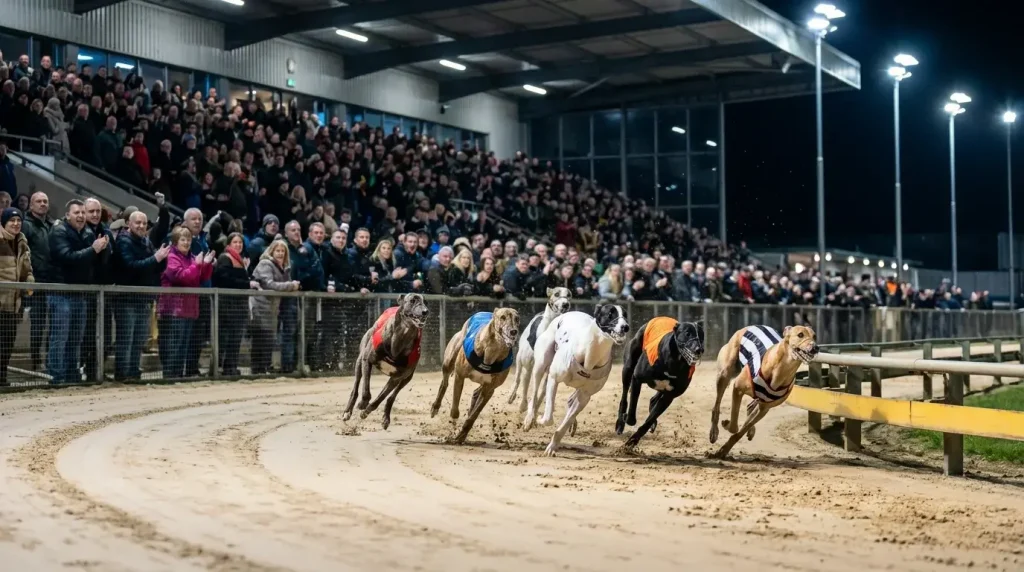
The English Greyhound Derby — History of the Sport’s Showpiece
The English Greyhound Derby is the single most important race in UK greyhound racing. First run in 1927 at White City Stadium in London, the Derby has endured through nearly a century of change — surviving stadium closures, relocations, war, and the commercial evolution of the sport — to remain the race that defines careers, creates legends, and commands the attention of the entire racing and betting community for the weeks it takes to resolve.
The Derby’s history is woven into the fabric of British sport. White City hosted the event for decades, establishing it as the greyhound equivalent of the Epsom Derby or the FA Cup Final — an occasion that transcended its sport and entered the broader public consciousness. When White City closed in 1984, the race moved to Wimbledon in 1985, where it continued to attract national media coverage and packed houses. The last Derby at Wimbledon was held in 2016, with the stadium closing permanently in March 2017, forcing the Derby to relocate and find its current home at Towcester in Northamptonshire.
The roll of Derby winners reads like a history of greyhound racing itself. Mick the Miller, the sport’s first celebrity, won back-to-back Derbies in 1929 and 1930 and became a household name. Patricia’s Hope won consecutive titles in 1972 and 1973. Rapid Ranger took back-to-back prizes in 2000 and 2001 in some of the most dramatic finals in the race’s history. Each winner takes its place in a lineage that stretches back nearly a hundred years, and each final produces a moment — a break from the traps, a run into the first bend, a finishing burst — that becomes part of the sport’s collective memory.
The Derby carries the highest prize money in UK greyhound racing. The exact purse varies by year, but the final typically awards a sum that dwarfs any other event on the calendar, reflecting the race’s status and its commercial significance. For owners, trainers, and breeders, winning the Derby is the pinnacle — the achievement against which every other result in the dog’s career is measured. For bettors, the Derby is the event that generates the most interest, the deepest markets, and the most intense ante-post speculation of any race in the sport.
Derby Format — From First-Round Heats to the Final
The English Greyhound Derby is not decided in a single race. It is a knockout competition that unfolds over several weeks, with the field of entrants gradually reduced through successive rounds until six dogs remain for the final. The format is designed to test consistency, adaptability, and nerve — a single fast run is not enough to win the Derby; a dog must perform at a high level across multiple rounds against varying opposition.
The competition begins with first-round heats, in which the entered dogs are drawn into six-dog races. The top finishers from each heat — typically the first two, though the format can vary — progress to the next round. Dogs that fail to qualify are eliminated, and the field narrows with each successive round. Quarter-finals reduce the field further, and the semi-finals — usually three races of six dogs each — determine the six finalists.
The semi-finals are often the most competitive races of the entire competition. By this stage, the weaker dogs have been eliminated, and the surviving runners are high-class performers capable of winning the title. The semi-final draws can make or break a campaign — a dog drawn against two other front-runners in a tight semi may face a harder task than a rival drawn in a more favourably composed heat. The draw for each round is conducted publicly, and the permutations it creates are a rich source of analysis and debate in the days between rounds.
The final is a single six-dog race over the standard Derby distance at Towcester. The trap draw is assigned, the dogs parade, the hare sets off, and thirty seconds later the sport has a new Derby champion. The compression of weeks of preparation, multiple qualifying rounds, and months of ante-post speculation into half a minute of racing is what gives the Derby final its particular intensity. There is no second chance, no replay, no aggregate scoring. The first dog past the post takes everything.
Towcester — Home of the Modern Derby
Towcester Greyhound Stadium in Northamptonshire first hosted the English Greyhound Derby in 2017, following the closure of Wimbledon Stadium. The track also staged the 2018 Derby before going into administration, which saw the event move to Nottingham for the 2019 and 2020 renewals. Towcester reopened under new management and has hosted the Derby continuously since 2021. The track is a purpose-built, modern facility with a 500-metre standard Derby distance, four bends, and a surface designed to produce fair racing. Its location in the Midlands makes it geographically accessible from most parts of England, though it lacks the metropolitan visibility that White City and Wimbledon once provided.
The track’s characteristics influence the Derby in specific ways. Towcester’s bends are moderately tight, favouring dogs with good bend speed and the agility to maintain position through the turns. The run from the traps to the first bend is a critical section — as at all tracks — and inside-drawn dogs with strong early pace have a tactical advantage. The surface is well-maintained for the Derby, typically providing consistent going throughout the competition, which helps produce reliable form from round to round.
Towcester’s role as Derby host has drawn investment and attention to the venue, and the stadium puts considerable effort into staging the event as a major sporting occasion. Finals night attracts a large crowd, and the atmosphere — floodlit track, packed grandstand, the tension of the year’s biggest race — recreates the sense of occasion that characterised the Derby at its previous homes. The venue may lack the London mystique of White City or Wimbledon, but it has established itself as a capable and committed host for the sport’s showpiece.
Ante-Post Betting on the Derby — Approach and Pitfalls
The Derby generates the longest and most active ante-post market in UK greyhound betting. Bookmakers open ante-post betting weeks before the first heats, offering prices on dogs that have been entered or nominated for the competition. Early ante-post prices reflect a combination of the dog’s current form, its kennel reputation, and the market’s assessment of its potential. They are speculative prices in a speculative market, and they carry specific risks that do not apply to race-day betting.
The primary risk of ante-post Derby betting is non-runners. Ante-post bets are struck on a “non-runner, no bet” basis only if the bookmaker explicitly offers that condition. Under standard ante-post rules, if your dog does not make it to the final — through injury, elimination in an earlier round, or withdrawal for any reason — your stake is lost. There is no refund. This risk is not trivial: the attrition rate through the Derby rounds is high, and many fancied dogs fall at the semi-final stage or earlier.
The compensating opportunity is price. Ante-post odds are typically more generous than the prices available on the morning of the final, because they reflect the additional risk of non-participation. A dog available at 10/1 in the ante-post market might be 5/1 on final night if it qualifies impressively. The bettor who takes the ante-post price and sees the dog reach the final has locked in a significantly better price — but has done so by accepting the risk that the dog might not get there.
A selective approach to ante-post Derby betting favours dogs with established consistency and robust physical condition — dogs that are likely to survive the qualifying rounds without injury or loss of form. It also favours early-round bets rather than pre-competition speculation, because each qualifying round provides fresh data that reduces the uncertainty. Betting ante-post on a dog that has just won its quarter-final impressively is a lower-risk proposition than betting on the same dog two weeks before the first heats, even if the odds are shorter.
The market also overreacts to individual round performances. A dog that wins its heat in fast time may see its ante-post price collapse, even though a single fast run at a favourable draw does not guarantee semi-final or final success. Conversely, a dog that qualifies with a workmanlike second place may see its price drift, creating value if the performance was stronger than the finishing position suggests. Reading the Derby market requires the same critical eye as reading the form — headline results do not tell the whole story.
Thirty Seconds That Make a Lifetime
The Derby final lasts approximately thirty seconds. The preparation lasts months. The speculation lasts weeks. The anticipation on finals night builds through twelve races of undercard action until the six finalists walk into the parade ring and the stadium holds its breath. Then the traps open, and everything that has been discussed, analysed, and wagered upon is compressed into the fastest half-minute in UK sport.
What makes the Derby special is not just the speed or the prize money or the history. It is the finality. One race. One chance. Six dogs at the top of their careers, running the most important race of their lives, and one of them will be remembered while the other five will be footnotes. The margins are tiny — a nose, a short head, a length at most — and the difference between winning and losing can be determined by a break from the traps, a nudge at the first bend, or a stride at the finish that separates glory from near-miss.
For the bettor, the Derby is the ultimate test of analysis, judgement, and nerve. Picking the winner from a field of the six best dogs in the country, having followed them through the qualifying rounds, is as demanding as greyhound betting gets. And when you get it right — when your dog hits the front off the final bend and crosses the line first under the floodlights at Towcester — it delivers a moment that no Tuesday afternoon BAGS double can match.
Find more race guides at greyhoundmeetings.
Also read our greyhound St Leger guide.
