
Greyhound Weight and Condition
 Available in US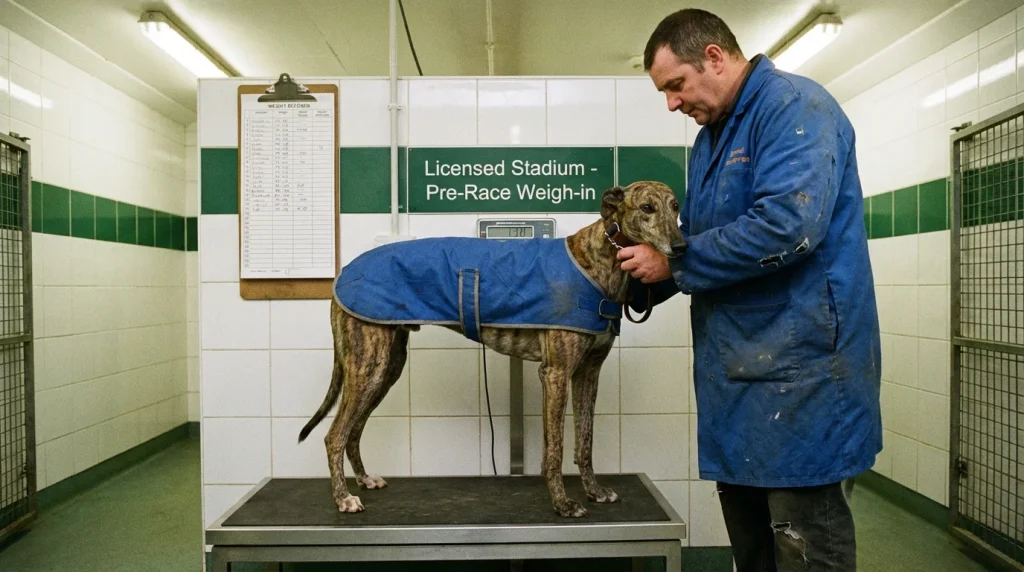
Weight and Condition — The Overlooked Racecard Data
The racecard gives you form figures, trap numbers, sectional times, and odds. All of these receive attention from bettors. Buried among them — usually in small print, easily skimmed past — is the dog’s weight. Most bettors glance at it and move on. This is a mistake, because weight is one of the few data points on the racecard that directly measures the dog’s physical state on the day of the race rather than reflecting what happened in a previous race at a different time under different conditions.
A greyhound’s racing weight is recorded at every meeting. The dog is weighed before the race, and that weight appears on the racecard alongside the weights from its recent previous races. Under GBGB Rule 52, a greyhound whose weight varies by more than one kilogram from its previous race or trial weight must be withdrawn and complete a trial before racing again. The comparison between these numbers — today’s weight versus last time, versus its average over the last six runs — tells you something about the dog’s current physical condition that no form figure can convey. A dog arriving at its normal racing weight is in a known state. A dog arriving a kilogram heavier or lighter than usual is in a different state, and the difference may be significant.
Weight data is not a standalone betting system. It is a diagnostic indicator — a piece of evidence that raises questions or confirms suspicions that your other analysis has already generated. But the fact that most bettors ignore it entirely gives it an informational edge that more widely studied metrics have lost. When everyone is looking at the same form figures, the bettor who also checks the weights is working with a marginally richer data set. Over hundreds of bets, marginal advantages compound.
What Weight Changes Signal About a Dog’s Fitness
Greyhounds are lean, finely tuned athletes. Their optimal racing weight is a narrow band — typically within half a kilogram of their best-condition weight — and deviations from that band can indicate changes in fitness, health, or preparation that affect performance. The key is knowing what the deviations mean and which ones matter.
A weight increase of half a kilogram to one kilogram from the dog’s recent average may indicate that the dog is coming back from a rest period and carrying a small amount of extra condition. This is common after a break of two weeks or more, and it does not necessarily indicate poor fitness — some trainers prefer to bring a dog back slightly heavier and race it into condition over two or three runs. However, a weight increase combined with a longer-than-usual gap between races may suggest the dog is returning from an injury layoff, in which case the extra weight is a sign that full race fitness has not yet been achieved.
A weight decrease of half a kilogram to one kilogram may signal that the dog has been in intensive training and is being sharpened for a particular race. Trainers who target specific events — a puppy derby heat, a step up in grade, a competition round — often bring their dogs in at the lighter end of their weight range, reflecting peak conditioning. This is a positive sign if the dog’s form has been solid and the trainer has a pattern of peaking dogs for specific targets.
A weight decrease that exceeds one kilogram from the dog’s normal range is a warning. Significant weight loss in a racing greyhound can indicate illness, stress, or overtraining. A dog that is racing too frequently, not recovering adequately between runs, or dealing with a health issue will lose condition, and that loss shows up on the scales before it shows up in the form figures. If you see a dog at a noticeably lower weight than its recent history, check whether the form figures support the concern — declining finishing times, weaker finishing efforts, or a pattern of deteriorating positions would confirm that the weight loss is affecting performance.
Consistency of weight is itself a positive indicator. A dog that arrives at the same weight — plus or minus a quarter of a kilogram — race after race is in a stable, well-managed condition. The trainer has the dog’s nutrition, exercise, and recovery dialled in, and the physical consistency supports consistent racing performance. When you are choosing between two dogs with similar form, the one with the more stable weight profile is typically the safer selection.
How to Read Condition Indicators on the Card
The racecard displays the dog’s weight for each of its recent races, usually alongside the race date and finishing position. The format varies by provider, but the information is always there. On Timeform’s racecard, the weight is shown in kilograms to one decimal place for each run line. On bookmaker racecards, the weight may be shown only for the current race and the previous race, requiring you to check the full form guide for the historical data.
The first step is to establish the dog’s baseline weight — its normal racing condition. Look at the last four to six races and calculate the average. If the dog has raced at 31.2, 31.4, 31.3, 31.2, and 31.5, the baseline is approximately 31.3 kilograms. Today’s weight of 31.3 is spot on. A weight of 31.8 is half a kilogram above baseline and worth noting. A weight of 30.7 is more than half a kilogram below and warrants investigation.
The second step is to check the trend. Is the weight stable, increasing, or decreasing across the last three runs? A rising trend might indicate a dog gaining condition after a rest, which could be positive or negative depending on the context. A falling trend might suggest a dog being sharpened for competition or, less encouragingly, a dog losing condition through overracing. The direction of the trend matters as much as the absolute number.
Visual condition — how the dog looks in the parade ring — supplements the weight data for bettors watching live at the track or on a stream. A dog that looks muscular, alert, and well-coated is presenting well regardless of what the scales say. A dog that looks dull-coated, listless, or tucked up through the abdomen may not be in optimal condition. These visual cues are subjective and require experience to interpret accurately, but they align with the weight data more often than not. A dog at its correct weight that also looks physically well is a dog in condition to perform.
Weight-Based Angles for Smarter Betting
Weight data is most useful as a confirming or cautionary signal layered on top of your existing form analysis. It does not replace the form figures, the draw assessment, or the grade evaluation. It refines them.
The strongest positive signal is a dog returning to its optimal weight after a period of being slightly above it, combined with recent form that shows improvement. This pattern suggests a dog that was slightly underdone in its recent races but is now approaching peak condition. If the form figures are already heading in the right direction and the weight confirms physical readiness, you have two independent indicators pointing the same way — a stronger basis for a bet than either signal alone.
The strongest cautionary signal is a dog whose weight has dropped notably below its baseline, especially if the form figures show a concurrent decline. This combination — weight loss plus performance decline — suggests a dog that is struggling physically, whether through illness, fatigue, or stress. Even if the dog’s recent form is not dramatically worse, the weight evidence adds a layer of concern that should reduce your confidence in the selection.
Weight stability over a long campaign is an underappreciated positive. A dog that has maintained its racing weight within a quarter-kilogram band over eight or ten consecutive runs is demonstrating physical durability and consistent management. These dogs are the reliable performers — the ones whose form figures are most likely to represent their genuine ability, because their physical state has been constant throughout the sample period. Backing well-managed, weight-stable dogs in their correct grade is one of the least exciting but most consistent approaches in greyhound betting.
One tactical application: when two dogs have similar recent form and you cannot separate them on the standard metrics, check their weight trends. If one is at baseline and the other is a kilogram above, the dog at baseline is the marginal preference. It is a tiebreaker, not a decision-maker, but in a sport where margins are thin, tiebreakers matter.
The Dog That Looks Right Usually Runs Right
Condition is not a mystery. It is a measurable, observable fact — recorded on the scales and visible to anyone watching the parade. The challenge is not access to the information but the willingness to use it. Most bettors scroll past the weight column because it seems minor compared to the drama of the form figures and the excitement of the odds. They are wrong. The form figures tell you what the dog did last week. The weight tells you what state the dog is in today. Both matter, and the bettor who integrates both into a single assessment is making a more complete evaluation than the one who relies on form alone.
Greyhound racing is a sport of fine margins. Dogs are separated by fractions of a second over distances covered in half a minute. In that context, a kilogram of extra weight — or a kilogram of lost condition — is not trivial. It is the difference between leading at the final bend and fading into third. The scales do not lie, and the dog that arrives at the track in the right physical condition has already cleared one of the hurdles that stands between it and a winning performance.
Get more form guides at greyhoundmeetings.
Also read our greyhound seasons and bitches in season.
