
Greyhound Racing Rules UK
 Available in US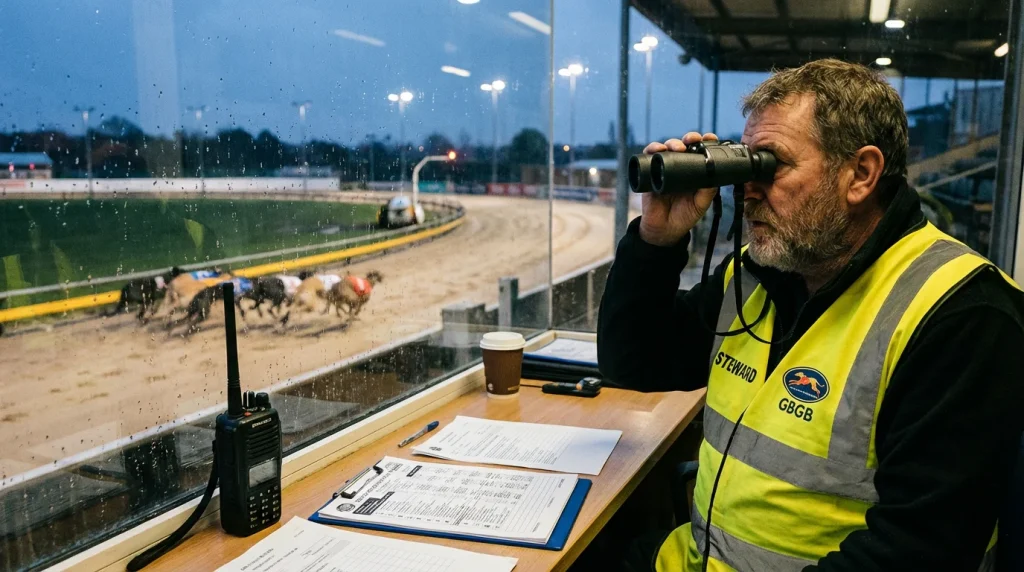
UK Greyhound Racing Rules — What GBGB Regulates
Every greyhound race at a licensed UK track operates under the Rules of Racing set by the Greyhound Board of Great Britain. The GBGB is the governing body responsible for regulating the sport: licensing tracks, registering dogs and trainers, overseeing race conduct, and enforcing integrity standards. If a race is run at a GBGB-licensed stadium — and the vast majority of UK greyhound racing takes place at licensed venues — it follows these rules without exception.
The GBGB rulebook covers every aspect of racing operations, from the dimensions of the starting traps to the procedures for weighing dogs before a race, from the duties of the racing manager to the powers of the stewards who oversee each meeting. For bettors, the rules that matter most are those that directly affect race outcomes and bet settlement: non-runners, reserves, void races, interference, and the circumstances under which results can be amended after the finish.
Understanding these rules is not academic. Knowing what happens when a dog is withdrawn before a race — and how that withdrawal affects your bet — is practical information that prevents surprises on your betting slip. Knowing how the stewards handle interference incidents helps you assess the risk that a result might be amended after the race. And knowing the conditions under which a race can be declared void protects you from assuming that a completed race always produces a final, settled result.
The GBGB publishes its Rules of Racing on its official website at gbgb.org.uk, and they are freely accessible. The full document is lengthy and legalistic, but the sections that affect bettors are relatively compact. What follows is a practical guide to the rules that most commonly come into play on a race-by-race basis.
Non-Runners, Reserves and Void Races
A non-runner is a dog that was declared to race but is withdrawn before the start. Non-runners occur for various reasons: injury discovered at the track, illness, failure to make the weight, a bitch found to be in season at the pre-race check, or a veterinary decision that the dog is unfit to race. The racing manager declares the non-runner, and the information is communicated to the track audience and the betting market as quickly as possible.
When a non-runner is declared, a reserve dog takes its place if one is available. The reserve inherits the vacant trap number and wears the corresponding jacket. The reserve’s form data will differ from the withdrawn dog’s, which means the composition of the race has changed — potentially significantly. For bettors who have already placed a bet on the withdrawn dog, the bet is void and the stake is returned. For bettors who have bet on other dogs in the race, the bet stands, but Rule 4 deductions may apply to the payout if the withdrawn dog was at a short enough price to affect the market.
If no reserve is available, the race may proceed with fewer than six runners. A five-dog race changes the dynamics significantly — one trap is empty, which affects the first-bend positioning and may give the adjacent dogs more room. Some bookmakers adjust their place terms for races with fewer than six runners, so check the rules for the specific operator you are betting with.
A race is declared void when the conditions for a valid race are not met. This can happen if the hare malfunctions and the dogs do not complete the course, if there is a false start that the stewards deem materially affected the result, or if an external interference — such as a loose animal on the track — renders the race unfair. When a race is voided, all bets on that race are cancelled and stakes are returned. Void races are uncommon but not negligible — they happen a handful of times across the UK calendar each month, and the bettor should be aware that a voided race means no payout regardless of the on-track outcome.
The timing of a non-runner declaration matters for your bet. If a dog is withdrawn before the official declarations are finalised — typically the morning of the race — the withdrawal may not trigger Rule 4 deductions because the market has time to adjust. If the withdrawal happens close to race time, after the market has formed and bets have been placed, Rule 4 deductions are more likely to apply. The precise rules for when deductions apply and at what rate depend on the withdrawn dog’s price at the time of withdrawal.
Interference, Objections and Stewards’ Enquiries
Greyhound racing involves six dogs sprinting into bends at high speed. Interference is not unusual — it is an expected part of the sport. Dogs crowd each other at the first bend, check each other’s stride mid-race, and bump on the final turn. The rules distinguish between normal racing incidents and interference serious enough to affect the result, and the stewards are responsible for making that judgement.
A stewards’ enquiry is called when the officials believe that interference may have materially affected the finishing order. The enquiry is conducted immediately after the race, and the stewards review the patrol camera footage — the equivalent of a photo finish review — to determine what happened and whether any dog gained an unfair advantage or was unfairly disadvantaged. The enquiry can result in the finishing order being amended, a dog being disqualified, or the result standing as it was.
Disqualification is the most severe outcome. A dog that causes serious interference — typically by impeding another runner’s progress to the extent that the interfered-with dog could not run on its merits — may be disqualified and placed last. The remaining dogs are promoted accordingly, which changes the payout for win, place, forecast, and tricast bets. If you backed a dog that finished second and the winner is disqualified, your dog is promoted to first and your bet is settled as a winner.
Objections can also be lodged by trainers or their representatives, though this is less common than stewards initiating their own enquiry. The objection process is similar: the stewards review the evidence and make a ruling. In practice, most enquiries are initiated by the stewards themselves, who have access to multiple camera angles and real-time observations from the track officials.
For bettors, the key implication is that the result you see on the screen immediately after the race may not be the final result. If a stewards’ enquiry is announced — typically signalled by a public address announcement and a flashing indicator on the results board — you should wait for the official result before celebrating or committing your winnings. Bookmakers settle bets on the official result after any enquiry is resolved, not on the initial crossing order.
How Rules Affect Your Bet
The connection between the rulebook and your betting slip is more direct than most casual bettors appreciate. Several common betting scenarios are governed entirely by the rules of racing, and understanding them prevents costly misunderstandings.
Non-runner refunds are automatic for bets placed on a withdrawn dog. Your stake is returned in full, and the bet is treated as though it never existed. However, bets on other runners in the same race remain live, and the payout may be reduced by a Rule 4 deduction. The deduction is applied to your winnings, not your stake, and the amount depends on the price of the withdrawn dog. A short-priced withdrawal triggers a larger deduction than a long-priced one, because the removal of a heavily fancied runner significantly changes the competitive landscape of the race.
Stewards’ amendments to the result are binding for betting purposes. If the finishing order changes after an enquiry, bookmakers settle bets on the amended result. This can work for or against you — a dog you backed might be promoted from second to first, turning a losing bet into a winner, or a dog that crossed the line first might be disqualified, turning your winning bet into a loser. There is nothing you can do about this except note the result and move on.
Dead heats — where two dogs cannot be separated for a finishing position — are settled by halving the bet at the full odds. If you backed a dog that dead-heats for first place, your return is calculated as though you bet half your stake at the full win odds. The other half of your stake is treated as a losing bet. Dead heats are rare in greyhound racing because the photo finish technology at licensed tracks is precise enough to separate runners by very small margins, but they do occur occasionally.
Void races result in full stake refunds for all bets on that race. This applies to all bet types — win, place, forecast, tricast, and any multiples that included a selection from the voided race. If the voided race was one leg of your accumulator, that leg is removed and the accumulator is recalculated on the remaining legs.
The Rulebook Protects the Sport — And Your Stake
The GBGB rulebook exists to ensure that greyhound racing in the UK is conducted fairly, safely, and with integrity. For bettors, it provides a framework of certainty: you know how bets are settled, what happens when things go wrong, and what recourse exists when the racing does not go to plan. This framework is not perfect — no set of rules can anticipate every eventuality — but it is comprehensive, consistently applied, and transparent.
Familiarising yourself with the key rules is not about becoming a regulatory expert. It is about knowing the ground rules of the game you are playing. When a non-runner is declared and your payout is reduced by a deduction, you should understand why. When a stewards’ enquiry amends the result and your winning bet becomes a loser, you should know that this is part of the process, not an error. And when a race is voided and your brilliant selection counts for nothing, you should recognise that the system is designed to protect the integrity of the sport — even when the immediate consequence is inconvenient for your pocket.
The rules are publicly available. The GBGB website has them. Your bookmaker’s terms and conditions reference them. A few minutes spent reading the sections on race conduct, non-runners, and result amendments will equip you with practical knowledge that most greyhound bettors never bother to acquire. That knowledge will not help you pick more winners, but it will help you understand what happens after you do — and that understanding is worth having.
Stay informed at greyhoundmeetings.
Also read our legal information.
