
Greyhound Distance Guide — Sprint to Stayer
 Available in US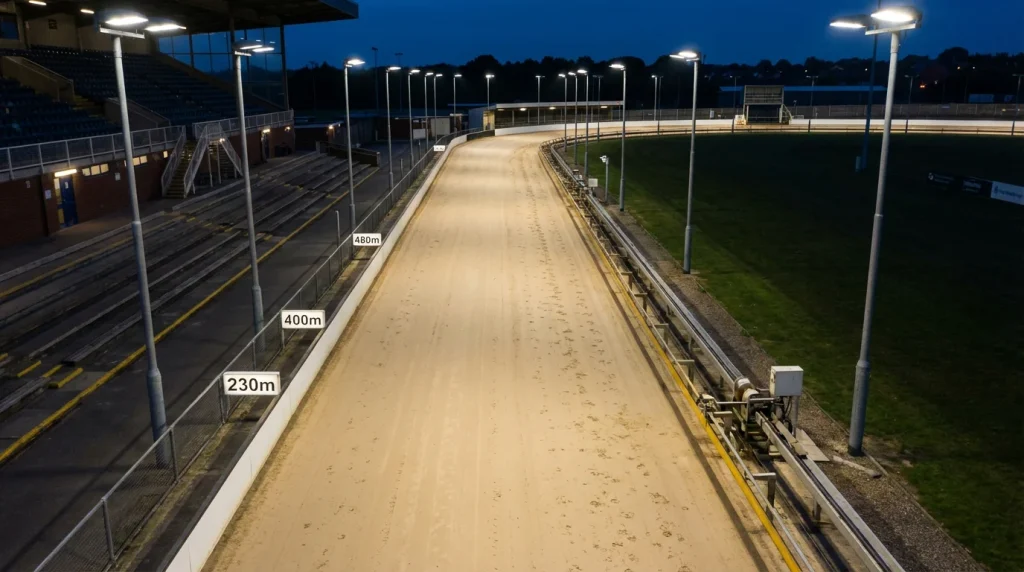
Distance Is the First Variable in Every Race
Before you look at the form, before you check the draw, before you assess the grade — look at the distance. Every greyhound has a distance range where it performs best, and running a dog outside that range is like entering a sprinter in a marathon. The form might look acceptable, the grade might be right, the draw might be favourable, but if the distance does not suit the dog, none of it matters.
UK greyhound racing covers a wide spectrum of distances, from sharp sprints of 230 metres to marathon staying events exceeding 900 metres. Each distance bracket demands different physical attributes, different running styles, and different tactical approaches. A dog that dominates over 270 metres may have no stamina for 480. A dog that grinds down opponents over 680 metres may lack the early pace to compete in a sprint. Distance preference is not a minor detail — it is a fundamental characteristic of every greyhound, as important as speed, fitness, or form.
The racecard shows you the distance of each race. The form guide shows you the distances at which each dog has previously raced and how it performed at each. Matching the two — identifying dogs running at their preferred distance and flagging those being tried at unfamiliar trips — is one of the simplest and most effective filters in greyhound betting. It costs nothing, it takes seconds, and it eliminates errors that more complex analysis cannot catch.
Sprint Distances — 230m to 300m
Sprint races are the shortest events on the card, typically covering 230 to 300 metres and involving one or two bends at most. Some sprints are run entirely on the straight at tracks that have a dedicated sprint course. They are over in less than twenty seconds, and the margins between the dogs are measured in hundredths of a second. There is no time for tactical racing. The dog that breaks fastest and carries its speed to the line wins.
The physical profile of a successful sprinter is distinct from a standard-distance dog. Sprinters tend to be lighter, more explosive, and built for acceleration rather than sustained effort. Their muscular composition favours fast-twitch fibres — the type that produce rapid bursts of power — over the slow-twitch fibres that support endurance. This is not something the racecard tells you, but it is reflected in the form: a dog with a sequence of fast run-up times but declining finishing efforts is showing the physical signature of a sprinter.
The trap draw is amplified in sprint racing. With only one or two bends, the position at the first turn is often the decisive factor. Inside-drawn dogs with good early pace have a clear advantage at tight-bending tracks because they can establish the rail position before the field bunches. The race unfolds so quickly that there is minimal opportunity for a badly positioned dog to recover. Sprint handicapping therefore places heavy weight on the combination of trap speed and draw — more so than in any other distance category.
Sprint races on the grading ladder are classified under D-grades at most tracks: D1 for the fastest sprinters down to D5 for the slowest. The form from D-grade sprints does not translate directly to A-grade standard-distance races and vice versa, because the disciplines are different. A dog graded D2 in sprints might have no form at standard distances, and entering it in a 480-metre race would be an experiment, not a continuation of its existing campaign.
For bettors, sprints offer both challenge and opportunity. The races are harder to predict because the margins are tiny and a fractional advantage at the start can determine the outcome. But they also tend to attract less analytical attention from the betting public, particularly at BAGS meetings, which means the market can be less efficient. A bettor who specialises in sprint racing — studying run-up times, trap statistics, and early-pace data — can develop an edge that is harder to build in the more heavily analysed standard-distance races.
Standard and Middle Distances — 400m to 500m
Standard-distance races form the backbone of UK greyhound racing. The most common distance across licensed tracks is approximately 480 metres, involving four bends and two straights. This is the distance at which the majority of graded races are contested, and it is the distance at which most dogs are assessed, classified, and compared. If you bet on greyhounds regularly, most of your wagers will be on standard-distance races.
The standard distance demands a balanced dog. Early pace matters — the first bend is still a critical juncture — but stamina, fitness, and the ability to maintain speed through four bends also play a role. The race is long enough for a dog that starts slowly to recover ground, unlike in sprints where a slow start is usually fatal. This makes standard-distance racing more tactical and more complex to analyse than sprinting, because the interaction between dogs unfolds over a longer period and more things can happen.
Middle-distance races, covering roughly 400 to 460 metres, sit between sprints and standard. They involve three or four bends and require a blend of pace and stamina that is subtly different from the 480-metre standard. Some tracks offer specific middle-distance trips — 440 metres at Romford, for example — that suit dogs caught between the sprint and the standard category. These middle-distance specialists can be tricky to assess because their form may include runs at both shorter and longer trips, and their best performance comes at a distance that not every track offers.
The grading system for standard distances uses A-grades: A1 at the top down to A11 at the lowest level. The grade reflects the quality of opposition the dog faces, and the standard distance is where the grading system is most developed, with the deepest pools of dogs and the most finely calibrated class distinctions. For the bettor, this means that grading movements — promotions and demotions — are most meaningful and most informative at standard distances, because the system has the largest sample of dogs to calibrate against.
Marathon and Staying Events — 600m to 900m+
Staying races are the endurance events of greyhound racing. Distances range from 600 metres through to marathon trips of 800, 900, or even over 1,000 metres at select tracks. These races involve six, eight, or more bends, and the physical demands are dramatically different from standard and sprint racing. The dog that wins a 900-metre race is not necessarily the fastest — it is the one that can maintain a strong pace over a sustained distance while conserving enough energy to finish.
Stayers have a different physical profile from sprinters and standard-distance dogs. They tend to be larger, with deeper chests and greater aerobic capacity. Their running style favours economy over explosiveness: smooth, efficient movement that minimises energy expenditure through the bends and allows for a strong finishing effort. The best stayers are often described as “galloping” dogs — they cover the ground with long, fluid strides rather than the rapid-fire action of a sprinter.
Staying races are less common on the daily card than standard-distance events. A typical meeting might include one or two races at staying distances among a card of twelve to fourteen events. Major staying races — the St Leger, the Gold Collar, the Edinburgh Cup — are among the most prestigious events on the greyhound calendar, reflecting the particular respect that the racing community holds for dogs with genuine stamina.
For bettors, staying races offer a distinctive challenge. The form data is thinner because dogs race less frequently over staying distances, and the pools of runners are smaller. At some tracks, the same group of stayers might compete against each other repeatedly over a period of months, creating form lines that are deeply interlinked. This can make analysis easier in some respects — you get to know the runners and their relative abilities — but harder in others, because a close-knit group of dogs can produce different results depending on the pace of the race, the going, and the draw.
Stamina is the dominant factor, but it is not the only one. Early pace still matters — a staying race with a strong pace from the start creates a different dynamic from one where the leaders go slowly and the race becomes a sprint finish. Reading the likely pace scenario is more important in staying events than at any other distance, because the pace determines whether the race favours front-runners or closers, and that distinction can swing the result.
Matching Dog to Distance — The Selection Principle
The simplest and most reliable betting filter in greyhound racing is the distance match. Check the dog’s form at today’s distance. If it has a record of strong performances at this trip — wins, places, fast times, positive run comments — the distance suits it. If its form at this distance is weak, or if it has never raced at this trip before, you have a legitimate reason for caution.
Dogs being tried at a new distance are the market’s wild cards. They might thrive — a standard-distance dog with exceptional late pace might relish the extra yardage of a staying trip, finding the longer race allows its finishing kick to be decisive. Or they might fade — the same dog might lack the stamina to maintain its pace over the additional bends and finish weakly. The racecard will show whether a distance is new for the dog, and the form guide will show whether the dog’s running style suggests it might cope. But the uncertainty is real, and the market should reflect it.
Build the distance check into the first step of your analysis. Before form, before draw, before grade — does this dog want to run this far? If the answer is clearly yes, proceed with your analysis. If the answer is unclear, proceed with caution. If the answer is clearly no — a confirmed sprinter in a 680-metre race, or a plodding stayer in a 270-metre dash — that is the simplest pass of the night. Not every betting decision needs to be complex. Sometimes the distance tells you everything you need to know.
Find more race guides at greyhoundmeetings.
Also explore our greyhound tracks distance and layout.
