
Greyhound Tote Betting Explained
 Available in US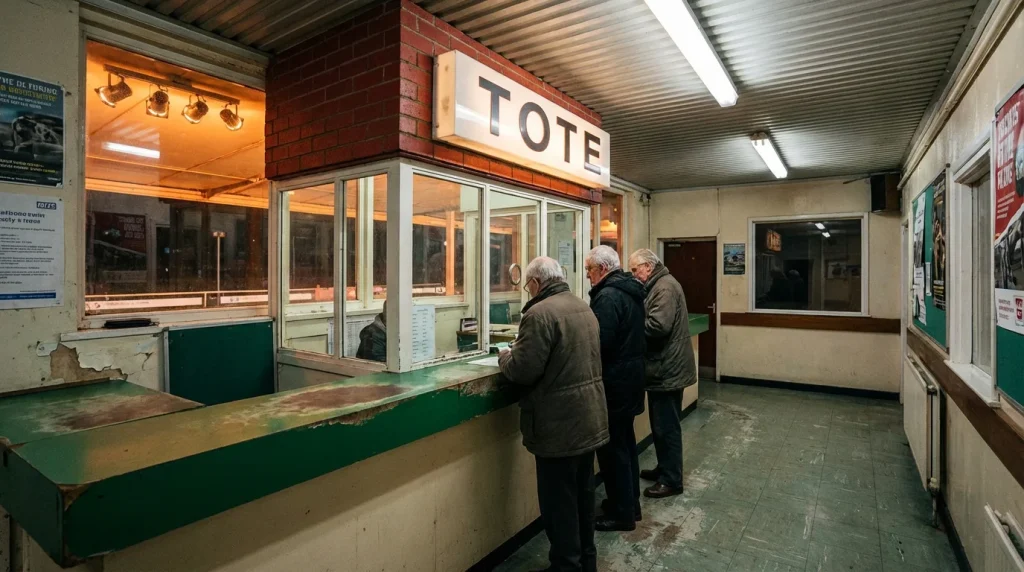
Tote Betting — How Pool Odds Differ from Fixed Odds
When you place a bet with a bookmaker, you know the price. When you place a bet with the tote, you know nothing until the race is over. That single difference — fixed odds versus pool odds — changes the entire nature of the wager. The tote collects all the money bet on a race into a pool, deducts a percentage for the operator and the track, and divides the remainder among the winning tickets. Your return depends not on a price agreed in advance but on how much money other bettors put into the same pool and which combinations they chose.
Pool betting has been part of UK greyhound racing since the tracks opened. The tote was the original form of legalised on-course betting — bookmakers came later — and at many stadiums it remains the primary betting facility alongside the on-course bookmakers’ pitches. The tote operates under the track’s authority, typically through the Totepool system, and offers a range of bet types that differ from the fixed-odds menu available through bookmakers.
For bettors, the distinction matters because pool odds are unknowable before the race starts. You can estimate the likely dividend based on the amount of money flowing into the pool and the distribution across the runners, but the final figure is only declared after the race. This uncertainty is the tote’s defining characteristic: it can pay more than the bookmaker’s odds on the same selection, or it can pay less. There is no way to guarantee which outcome you will get until the pool closes and the dividend is calculated.
The tote appeals to bettors who want to avoid the bookmaker’s built-in margin and are comfortable with the uncertainty of pool odds. It is also the only route to certain bet types — the jackpot, the Pick 6, the Scoop6 — that are not available through fixed-odds channels. Understanding how the tote works, where it offers value, and where it falls short gives you an additional dimension to your greyhound betting that most casual punters never explore.
Tote Bet Types at the Track
The tote at a UK greyhound stadium offers a menu of bet types that overlaps with, but is not identical to, the fixed-odds offerings from bookmakers. The core bets are win, place, forecast, and tricast — familiar to anyone who bets with a bookmaker — but the tote versions operate on pool mechanics, and some additional pool-only bets expand the range further.
The tote win bet is the simplest: pick the dog you think will finish first. All win pool stakes are combined, the track takes its deduction, and the remaining pool is divided by the number of winning unit stakes. The declared dividend tells you what each £1 winning ticket returns. If the tote win pool is £5,000 and after deductions £4,000 remains, and 200 unit stakes backed the winner, the dividend is £20. Your £1 bet returns £20.
The tote place bet pays out if your dog finishes first or second. The place pool operates independently from the win pool, with its own total and its own deduction. Place dividends tend to be lower than win dividends for obvious reasons — more tickets qualify for a payout — but they offer a return route for dogs that run well without winning. The minimum place dividend at most tote operators is set at a low threshold, typically £1.10 per £1 staked, ensuring you at least get a nominal return above your stake.
Tote forecasts follow the same principle as bookmaker forecasts — predict first and second in order — but the payout is a pool dividend rather than a calculated fixed price. Tote forecast pools tend to be smaller than win pools, which means the dividends can be volatile. A popular first-second combination that attracts heavy money might pay a disappointing dividend, while an unlikely result can produce a substantial return because few bettors held the winning combination.
The tote tricast pool — first, second, and third in order — is where the tote’s volatility is most visible. With 120 possible permutations in a six-dog race, the money in the tricast pool is spread thinly across many combinations. Winning tricasts frequently pay large dividends because the pool is shared among a small number of winning tickets. Conversely, if the three favourites finish in market order and many bettors hold the winning combination, the dividend can be surprisingly modest.
Beyond these standard bets, the tote at many tracks offers jackpot and Pick 6 pools — bets that require you to select the winner of multiple consecutive races. These are discussed in a separate guide, but they represent the tote’s unique territory: pool bets with no fixed-odds equivalent, offering life-changing dividends for a small stake when the pool rolls over unclaimed.
How Tote Payouts Are Calculated
The tote payout calculation is transparent in principle and opaque in practice. The formula is simple: total pool money minus the operator’s deduction, divided by the number of winning unit stakes. The complexity is that you cannot see the full pool composition until after betting closes, and the deduction rates vary by bet type and by tote operator.
Deduction rates — the percentage taken from the pool before dividends are calculated — typically range from 15% to 30% depending on the bet type and the operator. Win pools generally carry lower deductions, in the range of 13% to 16%. Forecast pools are usually deducted at a higher rate, around 20% to 24%. Tricast pools carry the highest deductions, sometimes reaching 26% to 30%. These rates represent the combined take of the tote operator and the track, and they are the equivalent of the bookmaker’s overround — the house edge built into the product.
The practical effect of the deduction is that the tote is not a zero-margin market. A significant chunk of the pool never reaches the bettors. On a win pool with a 15% deduction, only 85p of every pound staked is available for redistribution as dividends. The remaining 15p goes to the operator and the track. This is important context for anyone comparing tote dividends to bookmaker prices — the tote is not inherently “fairer” than the bookmaker simply because it is a pool. Both take their cut; the mechanisms are different but the economic principle is the same.
One subtlety of tote payouts is the effect of pool size. Small pools are more volatile: a handful of large bets on a single dog can dramatically compress the dividend for that dog while inflating the potential dividend for all other runners. At a quiet Tuesday BAGS meeting, the tote win pool might be only a few hundred pounds, and a single £50 bet on the favourite can move the implied odds significantly. At a Saturday evening premier meeting, the pools are larger and less susceptible to individual bets distorting the prices.
The minimum dividend rule also applies. If the calculation produces a dividend below the operator’s minimum — typically £1.10 for a win and £1.05 for a place — the dividend is rounded up to the minimum. This protects bettors from receiving a dividend that is less than or equal to their stake on heavily backed dogs, but it also means the operator absorbs a loss on those pools, which is factored into the overall deduction rates across all bet types.
Tote vs Bookmaker — When to Choose Which
The strategic question for greyhound bettors is not whether the tote or the bookmaker is better in absolute terms. It is which one offers better value on the specific race in front of you. The answer varies by race, by bet type, and by market conditions.
The tote tends to offer better value when you are backing outsiders. In a race where the market favourite has attracted most of the public money, the tote win pool will be heavily weighted towards that dog, inflating the potential dividend for the less popular runners. If the outsider wins, the tote dividend may exceed the bookmaker’s fixed odds because the pool was structured in the favourite’s favour. This dynamic is most pronounced in races with a single short-priced favourite and a spread of longer-priced runners.
Conversely, the bookmaker tends to offer better value when you are backing favourites. The bookmaker’s fixed odds on a favourite might be 6/4 or 2/1, which is a known return. The tote dividend on the same favourite, in a pool where heavy money has backed that dog, might work out to less than the bookmaker’s price because so many tickets share the winning pool. Backing favourites through the tote is generally a losing strategy relative to taking the bookmaker’s fixed price.
For forecast and tricast bets, the comparison is more complex. The bookmaker settles forecasts at the Computer Straight Forecast price or at pre-declared fixed odds, while the tote pays pool dividends. The CSF and the tote forecast dividend are often similar but not identical, and which one pays more depends on the specific result. Over a large sample, the difference tends to average out, but on any individual race either one can be significantly higher than the other.
One practical advantage of the tote is that your bet does not move the market against you. When you place a significant bet with a bookmaker, the price may shorten in response, reducing the value for subsequent bettors and potentially shortening your own price if the bookmaker reprices. With the tote, your money goes into the pool and affects the dividend only to the extent that it changes the pool composition — and since you do not know the final dividend until after the race, there is no visible price movement to react to. For bettors placing larger stakes at the track, this can be an advantage.
The Pool Is a Different Game — Play It Accordingly
Tote betting and fixed-odds betting are two different ways of engaging with the same race, and they require different mental models. The bookmaker gives you certainty and control: you know the price, you assess the value, you make your decision. The tote gives you participation in a pool whose final shape is determined by the collective behaviour of everyone who bet on that race. Your analytical skills still matter — you are still picking a dog to win — but your return depends partly on what everyone else did with their money.
This distinction favours the tote bettor who can identify situations where the public money has mispriced the field. If you consistently find dogs that the pool undervalues — outsiders in heavy-favourite races, runners at tracks where the tote pools are small and volatile — the tote can deliver better returns than the bookmaker over time. But this requires a different kind of market reading: not just form analysis, but an understanding of how other bettors are likely to distribute their money across the field.
Most recreational greyhound bettors will do perfectly well sticking to fixed-odds bookmakers for their day-to-day betting and using the tote primarily for pool-exclusive bet types like the jackpot or for on-track betting where the tote is the most convenient option. The tote is not superior or inferior to the bookmaker in any absolute sense. It is a different instrument, with its own strengths and weaknesses, and the bettor who understands both has a wider toolkit than the one who only uses one.
Find more bet type guides at greyhoundmeetings.
Also see our greyhound betting types explained.
