
How Greyhound Starting Prices Work
 Available in US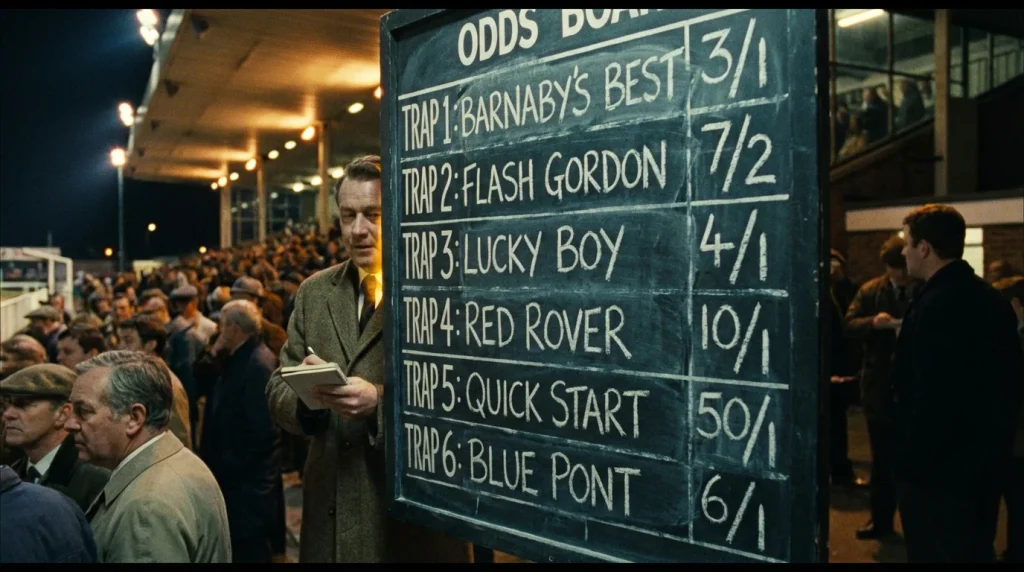
The Starting Price — Who Sets It and Why
The starting price is the last price available on a greyhound before the traps open. It is the benchmark against which all other prices are measured, the fallback for bets placed without a fixed price, and the reference point for promotions like best odds guaranteed. Despite its central role in greyhound betting, most punters have only a vague sense of where the SP comes from and what it actually represents.
In UK greyhound racing, the starting price is derived from the on-course betting market. At tracks where on-course bookmakers operate, the SP reflects the final odds offered by those bookmakers at the moment the race begins. An official SP reporter — typically employed by the Racing Post or an approved body — records the prices available from the on-course bookmakers just before the off and calculates the returned starting price. This price is then published and used to settle bets placed at SP with bookmakers and through the betting exchanges.
The process sounds straightforward, but there are layers to it that matter for bettors. The on-course market at a greyhound meeting is typically thinner than at a horse racing fixture. Fewer bookmakers operate on-course at the dogs, the money flowing through the ring is smaller, and the market can be influenced by relatively modest bets. This means the SP at a greyhound meeting is formed in a less liquid environment than its horse racing equivalent, which has implications for both its reliability and its susceptibility to manipulation.
At meetings where no on-course bookmakers are present — which is increasingly common, particularly at daytime BAGS meetings — the SP may be calculated using industry-standard methods based on the prices offered by the major online bookmakers at the time the race goes off. The methodology varies, but the principle is the same: capture the market price at the moment of the off and use it as the settlement price for SP bets.
Understanding the SP matters because it determines the settlement price for a significant volume of bets. If you bet without requesting a specific price — at the track, in a shop, or by selecting SP online — you receive whatever the starting price turns out to be. And if the SP is lower than the early price you could have taken, you have left money on the table.
How SP Differs from Board Prices and Exchange Odds
The starting price, the board price, and the exchange price are three different measures of the same thing — the market’s assessment of a dog’s chances — but they are formed in different markets with different dynamics, and they often diverge.
Board prices are the odds displayed by bookmakers, both on-course and online, throughout the betting period before a race. They are set by the bookmaker based on their own tissue (a set of predicted odds compiled before the market opens), adjusted as money comes in. Board prices move in response to supply and demand: if a dog attracts heavy betting, its price shortens, and the prices on other dogs in the race lengthen. The early board price — the first odds offered, sometimes hours before the race — is the bookmaker’s opening position, and it frequently differs from the SP.
Exchange prices are set by the bettors themselves on platforms like Betfair. The exchange is a peer-to-peer market where you can back a dog at a price offered by another user or lay it (bet against it) at a price you set. Exchange prices tend to be more efficient than bookmaker prices because the exchange has no built-in margin beyond a small commission on winnings. However, the greyhound markets on exchanges are notably less liquid than the horse racing markets. Prices can be volatile, the amount of money available at any given price may be small, and the market may not settle into a stable picture until the final minutes before the race.
The SP sits somewhere between the board price and the exchange price in terms of its information content. It captures the on-course market at a single point in time — the off — and is therefore a snapshot rather than a continuous measure. The board price, by contrast, evolves throughout the betting period and reflects the cumulative weight of money. The exchange price is the most dynamic and often the most efficient, but its utility in greyhound racing is limited by the thin liquidity on most races.
For the bettor, the practical question is which price to take and when. If you have done your analysis and identified a value bet, taking the early board price locks in your odds and removes the risk of the price shortening before the off. Taking SP means accepting whatever the market produces at the last moment — which might be better or worse than the early price. Exchange prices offer the potential for the best value but require you to navigate a thin market where your bet might not be matched at your desired price.
When Taking SP Makes Sense
The instinct of most serious bettors is to take a fixed price rather than SP, because the fixed price gives certainty and the opportunity to lock in value before the market moves. That instinct is generally correct. But there are specific situations in greyhound racing where SP is the more logical choice.
The first is when you expect the price to drift. If your analysis suggests that a dog is over-bet relative to its chances — perhaps it won last time out and the public are piling in — the early price may be shorter than the dog’s true probability warrants. Waiting for SP allows you to benefit from the price lengthening as the market corrects. This is a contrarian play, and it requires confidence in your own assessment against the weight of public money, but when it works, the SP returns significantly more than the early price would have.
The second scenario is when the early price information is unreliable. On some BAGS meetings, particularly at smaller tracks, the early prices offered by bookmakers may be set with minimal data and adjusted aggressively as money arrives. Taking an early price in this environment exposes you to the risk of having locked in a line that the market subsequently moves away from. Waiting for SP lets the market find its level before your bet is settled.
The third situation is live, on-course betting where you can see the dogs in the parade ring and at the traps. Physical condition, behaviour at the start, and the pre-race demeanour of the dog and trainer can all influence a late betting decision. Taking SP allows you to incorporate these last-minute observations into your bet without having to commit to a price set earlier based solely on racecard data.
In all other situations — particularly when you have identified a dog whose early price offers clear value relative to your form assessment — taking the fixed price is the superior play. The SP is a safety net for uncertainty. The fixed price is the tool for conviction.
SP Manipulation and Market Integrity
The thin on-course market at greyhound meetings makes the SP potentially vulnerable to influence in ways that the more liquid horse racing market is not. This is not a conspiracy theory — it is a structural observation about a market where a few hundred pounds placed at the right moment can visibly move the price of a dog in a six-runner field.
The GBGB and the UK Gambling Commission oversee integrity in greyhound racing, and suspicious betting patterns are monitored. Unusual late money, dramatic price movements inconsistent with early market activity, and correlations between betting activity and race outcomes are all flagged for investigation. The integrity framework is not cosmetic — investigations do result in sanctions, including bans for trainers and owners found to have engaged in corrupt practices.
From a bettor’s perspective, the integrity question affects SP bets more directly than fixed-price bets. If the SP has been influenced by a late gamble — whether legitimate or otherwise — the bettor who took SP receives a price that may not accurately reflect the true market. The bettor who took the early fixed price is insulated from this risk because their odds were locked in before the late activity occurred.
This is another argument in favour of taking early prices when you have a view. The more of your bets that are settled at a price you chose, the less you are exposed to the vagaries of a market that can be moved by a relatively small volume of money. SP is a reasonable settlement mechanism for bets placed without a price preference, but it should not be the default for anyone who takes their greyhound betting seriously enough to do pre-race analysis.
The broader market integrity picture in UK greyhound racing has improved substantially over the past decade, with better data monitoring, mandatory information sharing between bookmakers and the regulator, and clearer enforcement procedures. But the structural features of the SP market — low liquidity, few on-course operators, and the speed at which greyhound markets form — mean that the SP will always carry slightly more noise than the equivalent mechanism in horse racing.
The Last Price Standing
The starting price is the final word on a greyhound race’s market. After the traps open, there are no more prices, no more opinions, no more money to be placed. The SP freezes the market at the moment of truth and says: this is what the collective judgement was when it mattered.
For bettors, the SP should be understood as a reference point, not a target. It tells you what the market thought. It does not tell you what the dog was worth. Those are different things, and the gap between them is where profitable betting lives. If your assessment consistently identifies dogs whose true probability exceeds what the SP implies, you will make money over time — whether you take the SP or, more wisely, lock in a fixed price that captures that value before the market catches up.
Learn how the SP is formed. Track it against the early prices and exchange odds on the races you follow. Over time, you will develop a sense of the rhythm of greyhound price movements — which dogs tend to shorten, which tend to drift, and which meetings produce SPs that diverge most from the morning tissue. That knowledge, accumulated race by race, is one of the quieter edges available to the dedicated greyhound bettor.
Find more odds guides at greyhoundmeetings.
Also explore our greyhound racing odds and value bets.
