
Greyhound Trap Challenge Betting
 Available in US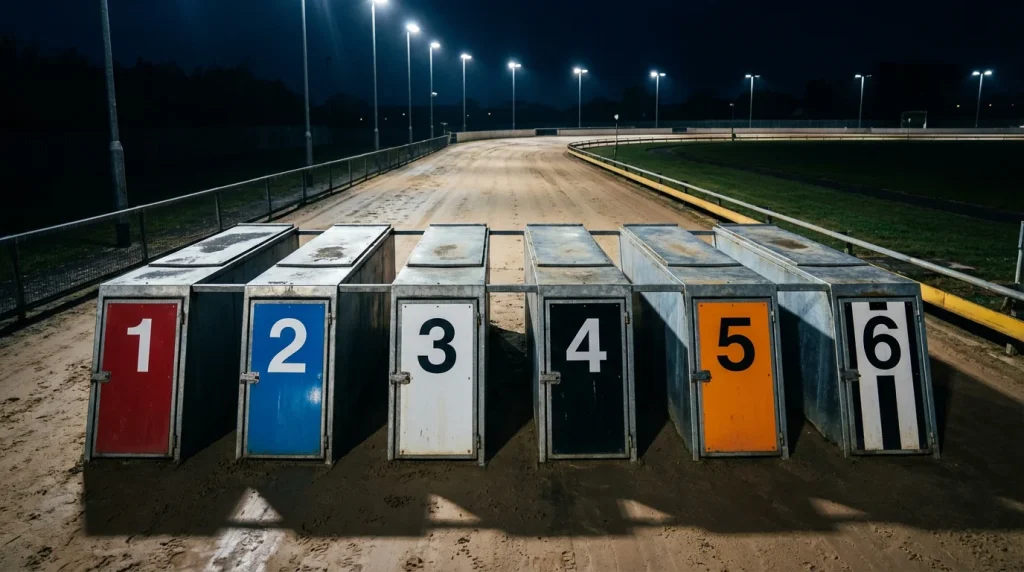
Trap Challenge — The Meeting-Long Market
Most greyhound bets are decided in thirty seconds. The trap challenge takes all afternoon. It is a market that runs across an entire meeting, asking which trap number will produce the most winners from the full card of races. Back trap 1, and you need the dog in the red jacket to win more races than any other trap number across twelve or fourteen events. It is a slow-burn proposition in a sport built on quick results.
Bookmakers offer trap challenge markets on most UK greyhound meetings, typically pricing each trap at roughly similar odds — often around 3/1 to 7/2 for each of the six traps — with the draw as the outsider at longer odds. The bet settles after the final race of the meeting. If two or more traps tie for the most winners, dead-heat rules apply, or the market is voided and stakes returned, depending on the bookmaker’s terms.
The trap challenge is often treated as a novelty bet, something to add interest to a long afternoon of racing when you do not have a strong view on individual races. That is a legitimate way to use it. But it also offers a lens through which to examine one of the most debated topics in greyhound betting: whether certain traps have a genuine statistical edge at specific tracks. If you approach the trap challenge analytically rather than casually, it becomes a test of your track knowledge rather than a random flutter.
The question, of course, is whether the bookmakers’ prices on the trap challenge accurately reflect the underlying probabilities — or whether there are spots where the market misprices a trap’s chances. Answering that question requires data, and the data is more interesting than you might expect.
How Bookmakers Price the Trap Challenge
Bookmakers set trap challenge prices based on a combination of historical trap performance data and their own margin requirements. Because each trap wins approximately one-sixth of all races on average, the starting point for pricing is that each trap has a roughly equal chance of topping the meeting. The bookmaker then adjusts for the specific track, the number of races on the card, and any known bias before applying their margin.
A typical trap challenge market on a twelve-race card might price each trap at 7/2, with the draw at 7/1 or 8/1. That pricing implies each trap has roughly a 20% to 22% chance of winning the challenge, with the remaining probability assigned to the draw outcome. The overround — the total of all implied probabilities — will exceed 100%, as it does in every betting market, giving the bookmaker their built-in edge.
The number of races on the card matters significantly for trap challenge pricing and outcomes. A meeting with 14 races provides more opportunity for a genuine trap bias to express itself over the session. A shorter card of 8 or 10 races increases the randomness — one or two lucky results for a particular trap can swing the outcome. Bookmakers account for this by widening margins on shorter cards and offering tighter prices on longer ones, though the adjustment is not always proportional to the statistical reality.
One subtlety in the pricing is that bookmakers typically assume a roughly equal distribution across traps, even at tracks where historical data shows a persistent lean. If trap 1 has won 19% of races at a venue over the past year while trap 6 has won 14%, the bookmaker may not fully price in that five-point gap. This is partly because the data is publicly available and the bookmaker expects knowledgeable bettors to exploit any obvious mispricing, but it is also because the sample size for a single meeting is too small for historical averages to be strongly predictive.
Historical Trap Win Rates by Track
Trap win rates across UK greyhound tracks have been tracked and published by multiple sources, including OLBG, Timeform, and the SIS Racing statistics section. The data paints a nuanced picture: aggregate trap performance is close to equal across the sport, but individual tracks show persistent variations that are statistically meaningful over large samples.
At the aggregate level across all UK tracks, trap 1 tends to win slightly more often than the other traps, typically in the range of 17% to 19% compared to the theoretical 16.7% for a perfectly balanced system. Trap 6 tends to win slightly less often, usually in the 14% to 16% range. The middle traps — 2 through 5 — cluster around the expected average. This mild bias towards inside traps reflects the geometric advantage of a shorter run to the first bend and the inside rail position through the turns.
At the track level, the picture becomes more varied. Tracks with tight first bends — Romford is the most cited example — tend to show a stronger inside-trap bias. The short run from the traps to the first turn at Romford means that dogs drawn inside can establish position before the field bunches, giving them a tactical advantage that persists through the race. Over a full year of racing at Romford, trap 1 might win 19% to 20% of races, a gap of two or three percentage points over the outside traps.
Tracks with longer runs to the first bend or more sweeping turns — Central Park, Towcester — tend to show flatter trap distributions. The extra distance allows outside-drawn dogs to settle into their stride and find position without being squeezed, reducing the inside-trap advantage. At these venues, the difference between the most and least successful traps over a year may be just one or two percentage points.
Sprint races amplify trap effects more than standard-distance races, because the entire contest unfolds over one or two bends. In a sprint, the first-bend position is often the decisive factor, and the trap draw is the primary determinant of first-bend position. Over standard distances with four bends, the initial advantage is diluted by subsequent corners and the longer run-in to the finish.
The important caveat with all trap statistics is sample size. A full year of racing at a single track might produce 3,000 to 5,000 individual races — a robust sample for identifying broad trends. A single meeting of 12 races is a tiny sample where random variation dominates. The historical trap win rate at a track tells you something useful about the long-term tendency, but it tells you very little about which trap will win the most races on any given Tuesday afternoon.
Is There Value in the Trap Challenge?
The honest answer is: sometimes, but not reliably. The trap challenge is a high-variance bet with a small number of possible outcomes (seven, if you include the draw) and a moderate bookmaker margin. Finding consistent value requires a combination of track-specific knowledge, an understanding of the card composition, and a willingness to pass the bet entirely when the conditions do not favour it.
The strongest case for value arises when the card composition at a particular track skews towards race types that amplify trap bias. A meeting at Romford that includes a high proportion of sprint races, where inside traps have a documented advantage, might offer value on trap 1 or trap 2 if the bookmaker has priced the challenge as though the card were a standard mix of distances. Conversely, a meeting composed primarily of marathon-distance races at a track with wide bends might undermine any trap bias, making the draw outcome more likely.
In practice, most trap challenge markets are priced closely enough to their true probabilities that the edge, if it exists, is small. The bet is best understood as a low-stakes engagement tool — something that keeps your interest alive across a full meeting when you do not have strong views on individual races. Treating it as a serious profit centre would require a volume of data analysis and meeting-specific card review that most bettors are not willing to invest.
If you do want to take the trap challenge seriously, the approach is to focus on tracks you know well, review the card composition before the meeting, and only bet when the meeting structure gives a particular trap a demonstrable advantage that the market price does not fully reflect. Pass the challenge on meetings where the card is mixed, the track shows no significant bias, or the prices are tight enough that even a correct read would yield minimal profit.
A Side Bet That Teaches You About Track Bias
The trap challenge may not be a consistent money-maker, but it has an unexpected educational benefit. Engaging with it seriously forces you to study trap statistics, card composition, and track geometry in a way that most individual race bets do not. The process of evaluating whether trap 1 has a genuine edge at a particular meeting requires you to look at the same data that informs intelligent race-by-race betting: sectional times, first-bend statistics, distance splits, and running-style profiles.
Bettors who work through the trap challenge analysis and then apply that knowledge to their individual race selections are doing something more valuable than the trap challenge itself. They are building a model of how the track works — which traps benefit from the geometry, which distances amplify the bias, and which race types make the draw irrelevant. That model has applications far beyond the trap challenge market.
Think of the trap challenge as a training exercise with stakes attached. The bet itself might return a modest profit or a modest loss over a season. The knowledge you accumulate in the process of making those bets — if you approach it seriously — will inform every other greyhound bet you place at that track. And that, ultimately, is worth more than any trap challenge dividend.
Find more bet type guides at greyhoundmeetings.
Also read our greyhound accumulator betting.
