
Greyhound Grading System UK
 Available in US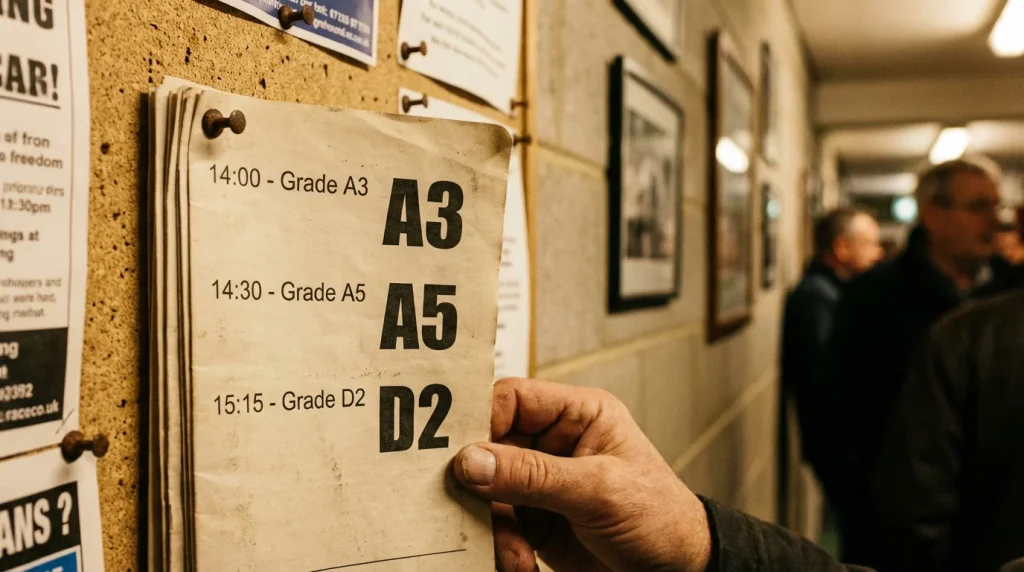
Grades Are the DNA of Every Greyhound Race
Before you look at form, look at the grade. Every greyhound race staged at a GBGB-licensed track in the UK is assigned a grade, and that grade tells you more about the nature of the contest than any individual dog’s recent results. It defines the standard of competition, sets the boundaries of the field, and provides the framework within which form data becomes meaningful. Without understanding the grading system, you are reading racecards with one eye closed.
The grading system exists to ensure competitive, safe racing. Its purpose is to group dogs of broadly similar ability together so that races are contested between animals operating at comparable levels. This prevents situations where a clearly superior dog demolishes a weak field — races that are bad for welfare, bad for spectacle, and bad for betting markets. The system is not perfect, and we will get to its imperfections, but the principle is sound and the execution is consistent across UK tracks.
For bettors, grading is the first filter you should apply when assessing a race. A dog’s recent form only makes sense when you know the grade it achieved that form in. A string of second-place finishes in A3 company tells a fundamentally different story than the same results in A8 company. The numbers on the racecard are the same — but the competition they were achieved against is not, and that difference is everything.
Grading is also the mechanism through which dogs move up and down the competitive ladder, and those movements create some of the most reliable betting angles in the sport. Spotting a dog about to face weaker opposition — or one being stepped up prematurely — requires an understanding of how the system works. That understanding starts here.
A-Grades, D-Grades, and What They Tell You
A1 is the top. D5 is the bottom. The distance between them is wider than most bettors think. The UK grading system uses two primary classification streams: A-grades for standard distances and D-grades for sprint distances. Within each stream, the numbers run from 1 at the highest level down to the lowest, with A-grades typically running from A1 to A11 and D-grades from D1 to D5, though the exact range varies slightly by track.
A-grade races are contested over standard distances, which at most tracks means races of approximately 400 to 500 metres involving four bends. A1 is the top tier — these are the fastest, most consistent dogs at the venue, and races at this level are the most competitive and often the hardest to predict. The fields are strong, the times are quick, and the margins between the dogs are typically tight. As you move down the A-grades, the average ability of the runners decreases. A5 is a solid mid-grade where dogs are competent but not exceptional. By A9 or A10, you are looking at the slowest runners in the standard-distance programme.
D-grade races cover sprint distances, usually between 230 and 300 metres, involving fewer bends — often just one or two. D1 represents the fastest sprinters at the track, while D5 fields are the weakest. Sprint racing is a different discipline from standard racing. It rewards raw trap speed and early pace more than stamina or tactical ability, and the grading reflects this. A dog graded D2 in sprints may have no form at standard distances and would be inappropriately entered in an A-grade race.
Some tracks also use other classifications. Open races sit outside the grading system entirely — they are invitational events for higher-calibre dogs, often carrying prize money and forming part of the major competition calendar. Handicap races, denoted by HP or OR, use a staggered-start system to equalise dogs of different abilities and are graded separately. You will also occasionally see maiden races for dogs that have not yet won, and puppy races restricted by age.
The critical point for bettors is that grades are track-specific. An A3 dog at Romford is not necessarily the same standard as an A3 dog at Monmore. Each track sets its own grading scale based on the population of dogs racing there. A small track with a shallow pool of runners may have a compressed grading range where the gap between A1 and A5 is smaller than at a larger venue. This matters when a dog transfers between tracks — a movement that the racecard will show but that the grade alone does not fully explain.
Timing data helps bridge this gap. If you know the standard times for each grade at a track, you can roughly calibrate a dog’s ability against the scale at a different venue. But the simplest rule is this: treat grades as relative to the track, not as an absolute measure of ability across the sport.
How Dogs Move Up and Down the Grading Ladder
Win, and you go up. Lose consistently, and you drop. The basic mechanism of grading movement is straightforward, though the execution involves more nuance than that one-sentence summary suggests.
Each track’s racing manager is responsible for grading decisions, guided by GBGB regulations and the dog’s recent racing record. The primary trigger for a grade change is performance. A dog that wins its race will generally be moved up — either one grade or sometimes two, depending on the margin of victory and the time recorded. A dog that has been consistently finishing in the lower positions over several races may be dropped a grade to find a level where it can be competitive.
The speed of movement varies. Some dogs rocket up the grades after a sequence of impressive wins, moving from A7 to A3 in a matter of weeks. Others settle at a particular level and race there for months, winning occasionally and losing occasionally in a pattern that neither triggers promotion nor demotion. Dogs that are declining — through age, injury recovery, or loss of form — may slide down the grades over several months.
Trainers have some input into the process, particularly when it comes to distance changes or moves between tracks. A trainer might request that a dog be tried over a shorter distance, effectively moving it from the A-grade stream to the D-grade stream. Alternatively, a trainer might move a dog to a different track where the grading conditions or circuit characteristics might suit it better. These trainer-initiated moves are often worth noting on the racecard, because they can indicate that the trainer believes the dog has untapped potential in a different context.
The grading system also accounts for time off. A dog returning from a layoff — due to injury, season, or other reasons — may be re-graded based on its last known form, with adjustments made if the absence has been lengthy. The racecard will typically note when a dog has been absent for an extended period, and the grading on return is one of the first things an experienced bettor checks.
One subtlety that many casual bettors miss is the concept of grading on collateral form. If a dog has been beaten by a runner that subsequently won several grades higher, the racing manager may take that into account when deciding whether to promote or hold the dog at its current level. These judgement calls add a layer of subjectivity to what might seem like a purely mechanical system, and they occasionally create situations where a dog appears under-graded or over-graded relative to its recent results.
Using Grading to Spot Betting Value
A dog dropping a grade is not always getting worse. In fact, some of the best betting opportunities in greyhound racing come from understanding why a dog has been re-graded and what that movement implies for its chances in the new context.
The classic value scenario is the dog dropping down after running creditably in a higher grade. Suppose a dog has been racing in A4 company and finishing third or fourth consistently — good enough to suggest it belongs at that level, but not quite fast enough to win. It gets dropped to A5. In its first race at the lower grade, it faces weaker competition, and its established form gives it a clear edge over dogs that have been struggling at A5 for weeks. The racecard shows the grade change, the form lines show competitive performances at a higher level, and the market should reflect this — but it does not always do so accurately.
The opposite scenario — a dog being promoted after a win — also creates value, though in the other direction. A dog that won an A7 race narrowly, in a slow time, against a weak field may be promoted to A6 where it is now facing significantly better opposition. The market might give this dog more respect than it deserves, based on its recent winning form, when the reality is that it has been promoted beyond its natural level. Opposing recently promoted dogs in their first run at the higher grade is a well-known angle among experienced greyhound bettors.
Track transfers create a third category of grading-based value. When a dog arrives at a new track, its initial grading may not perfectly reflect its ability relative to the resident dogs. A dog graded A5 at a strong track might be the equivalent of A3 at a weaker one. If the racing manager grades the newcomer based on its previous track grade without fully adjusting for the quality difference, the dog could be under-graded for its first few runs. The bettor who recognises this — by comparing times, by knowing the relative strength of different tracks — has information that the market may not have absorbed.
The key discipline is to use grading as a starting point for analysis, not an endpoint. A grade change is a signal that something has shifted — the dog’s form, the trainer’s plans, or the racing manager’s assessment. Your job as a bettor is to evaluate whether the new grade accurately reflects the dog’s current ability, or whether the market has not yet caught up.
Grade First, Form Second
The grade frames the conversation. Everything else is commentary. This might sound reductive, but it captures an important hierarchy of analysis that too many bettors invert. They start with the form — which dog won last time, which dog has the fastest recent time — and treat the grade as background information. The more productive approach is to start with the grade and ask what it tells you about the nature of the race before you look at a single form line.
Is this a race at the top of the grading scale, where every dog is sharp and the margins are measured in hundredths of a second? Or is it a lower-grade affair where inconsistency is the norm and a dog with superior early pace might dominate regardless of its recent results? The grade sets the context, and the context determines which form factors matter most.
Build the grading filter into the beginning of your assessment process. Check the grade first. Identify any dogs that have moved grades since their last run. Note any track transfers. Then, and only then, turn to the form data. You will find that the form reads differently — more clearly, more usefully — when you already know the competitive context it was produced in. That clarity is what turns a casual glance at the racecard into a structured evaluation of the field, and structured evaluation is what separates bettors who last from bettors who do not.
Find more race guides at greyhoundmeetings.
Also read our greyhound handicap races explained.
