
Greyhound Trap Colours and Draw Bias Explained
 Available in US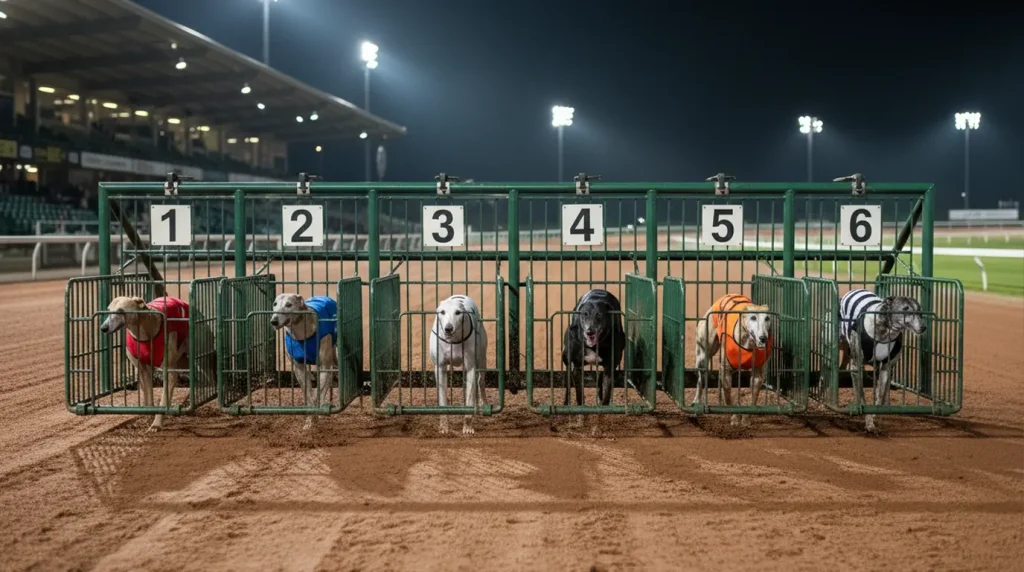
Six Traps, Six Colours — What They Mean
Red, blue, white, black, orange, striped — every dog wears its trap on its back. Walk up to any UK greyhound track and you will see six dogs lining up behind the mechanical hare, each wearing a numbered racing jacket in a fixed colour. The colour system is not decorative. It exists so that spectators, stewards, and bettors can identify each runner from any angle of the stadium, at any point in the race, under floodlights or in broad daylight.
This identification system has been standardised across every Greyhound Board of Great Britain licensed track for decades. Whether you are watching a Tuesday afternoon BAGS card at Sunderland or the Greyhound Derby final at Towcester, the same six colours apply. For anyone placing a bet — on-track, in a betting shop, or online — knowing the trap colours is the baseline. You cannot follow a race, evaluate a position at the first bend, or assess interference without it.
But the trap number is more than an identification tool. It determines where the dog starts — inside rail or outside — and that starting position feeds into every tactical calculation a serious bettor makes. The draw is not random noise. At certain tracks, on certain distances, it carries measurable weight. The question is how much weight, and that is where most casual bettors get it wrong. They either ignore the draw entirely or treat it as a magic formula. The reality sits in between, and getting that calibration right is worth the effort.
Understanding trap colours is a five-second exercise. Understanding what the trap draw means for the outcome of a race takes considerably longer. Both start here.
The Colour Code for Each Trap Number
The trap-to-colour assignment is universal across UK greyhound racing. There are no exceptions, no track-specific variations, and no changes based on the grade of race. Every bettor should commit this to memory, because it is the visual language of every race broadcast and every piece of form data you will ever read.
Trap 1 is red. Trap 2 is blue. Trap 3 is white. Trap 4 is black. Trap 5 is orange. Trap 6 is black and white stripes. This sequence has remained consistent for the entire modern history of regulated UK greyhound racing and is codified in GBGB Rule 118. The colours are visible on the racing jackets that dogs wear from the parade ring through to the finish line, and they appear alongside form data on racecards from every provider — Timeform, Sporting Life, Racing Post, and the bookmaker interfaces you will use to place your bets.
In a standard six-runner race, the trap number also determines the physical starting position. Trap 1 is closest to the inside rail. Trap 6 is furthest out. When the traps open, each dog breaks into a sprint towards the first bend, and their starting positions dictate the angles they take. A dog in trap 1 has the shortest route to the rail but can get squeezed if it breaks slowly. A dog in trap 6 has open ground on its outside but a longer path to the first bend and the risk of being pushed even wider.
When a non-runner is declared and a reserve takes its place, the reserve inherits the vacant trap number and wears the corresponding jacket. The reserve’s form data will often show a different trap preference, and this mismatch between preferred draw and actual draw is one of the subtle edges that attentive bettors look for.
On racecards, you will see the trap number displayed alongside, or colour-coded into, the runner information. Online bookmakers typically use the standard colour scheme in their greyhound racing interfaces. Getting fluent in reading these quickly — especially when races go off every 15 minutes — removes one layer of friction between you and a well-considered bet.
Does the Trap Draw Affect Who Wins?
Statistically, trap bias is smaller than most bettors assume — but it is not zero. The real answer depends on the track, the distance, and the running style of each dog in the field. Treating the draw as a simple “trap 1 always wins” or “trap 6 never wins” model is a recipe for losing money. Treating it as irrelevant is equally costly.
Across the full population of UK greyhound races, trap win percentages tend to cluster fairly tightly. In a perfectly balanced world, each trap would win roughly 16.7% of six-runner races. In practice, most traps at most tracks win somewhere between 14% and 20% of their races over a full calendar year. The variance is real, but it is not dramatic. OLBG publishes annual trap statistics by track, and the data consistently shows that no single trap dominates any track by a margin that would make blind trap-based betting profitable after the bookmaker’s margin is factored in.
That said, certain track configurations create conditions where specific traps have a structural advantage. Tight first bends tend to favour inside traps because the dog on the rail has a shorter run to the turn and can establish position before the field bunches up. Wide, sweeping first bends reduce this advantage because outside runners have more room to hold their line without being crowded. Tracks with a short run from the traps to the first bend — Romford is the classic example — amplify draw effects because dogs have less time to find their natural running positions before they hit the turn.
The distance of the race interacts with the draw too. Sprint races over 250 to 300 metres often involve only one or two bends, and the trap advantage can be more pronounced because there is less race left for a dog to recover from a poor position at the first turn. Over middle distances and marathon trips, the effect of the draw fades as the race unfolds, because dogs have more bends and more straights to find their rhythm and make up ground.
Running style is the third variable, and it is the one that most trap-obsessed bettors neglect. A front-running dog drawn in trap 1 at a tight track has an obvious positional advantage. The same dog drawn in trap 6 faces a harder task. But a dog that runs wide naturally — a dog whose form lines show it consistently racing in the outer lanes — may actually benefit from an outside draw that keeps it clear of traffic. The draw matters, but it matters in context, not in isolation.
One more nuance worth noting: trap statistics published for individual tracks are historical averages. They tell you what has happened across thousands of races, not what will happen in the specific race you are betting on. A trap 1 win rate of 19% at a given venue means that trap 1 won about one in five races over a long period. It does not mean the dog in trap 1 today has a 19% chance of winning. That dog’s chance depends on its own ability, fitness, recent form, and how it matches up against the other five runners — all factors that the trap statistic does not capture.
Using Draw Data Without Overreacting
Trap data is a filter, not a system. The moment you start backing dogs based primarily on their trap number, you have crossed from analysis into superstition. The draw is one input among many, and the best bettors use it to refine selections that are already justified on form, rather than as a stand-alone selection criterion.
Here is a practical approach. When you have assessed the field on form and identified two or three dogs with realistic winning chances, check their draw. If one of your fancied runners has a favourable trap for the track and distance — particularly at a venue where your data shows a meaningful trap skew — that is a positive. It might tip a marginal decision. It should not override a significant form advantage that another runner holds.
Where the draw becomes more influential is in competitive, evenly matched races. If form analysis tells you that four of the six runners could realistically win, and you cannot separate them with confidence, then the draw becomes a useful tiebreaker. The dog drawn on the inside at a tight-bending track might deserve the nod over an equally rated rival drawn wide. This is a sensible, proportional use of draw data.
Another legitimate application is identifying when a dog has been badly disadvantaged by the draw. A wide runner drawn in trap 1 at a track with sharp bends will likely get trapped on the rail, forced to check its stride, and lose lengths it cannot recover. Recognising this allows you to either oppose that dog or, if you think it is the best dog in the race, adjust your expectations about its chances and the price at which you are willing to back it.
What you should avoid is retroactive reasoning. After a dog loses from trap 6, it is easy to blame the draw. Sometimes the draw was the problem. More often, the dog was simply not fast enough, fit enough, or well enough positioned in the grading to win that race. The draw provides a convenient excuse for losses, and that convenience is its danger. Keep your analysis honest. A bad draw can cost a dog a length or two at the first bend. Rarely does it cost a clearly superior animal the entire race.
Track-specific draw data is worth collecting over time if you focus your betting on particular venues. A notebook — or a spreadsheet, if you prefer — that records trap results across a season at your regular tracks will tell you more than any published national average. Your own data, from the races you actually bet on, is inherently more relevant than a top-line statistic that blends every grade and distance at the venue into a single number.
The Jacket Tells a Story — If You Know How to Read It
Track-specific patterns emerge only if you are looking for them, and only if you resist the temptation to overfit what you find. The trap draw is one of the most seductive elements of greyhound racing because it feels like a shortcut. A number, a colour, a statistic — it all seems clean and simple. But greyhound racing is a sport contested by living animals with individual running styles, variable fitness, and the capacity to behave unpredictably when six of them sprint into a bend at up to 45 miles per hour.
Use the trap colours to follow the race. Use the trap number to understand starting positions. Use trap statistics to add context to your form assessment. Do not use any of it as a replacement for the harder, slower work of reading the racecard, assessing the field, and making a judgement about which dog is most likely to win the race in front of you today.
The jacket tells you where the dog starts. Everything that happens after the hare passes the traps is decided by ability, fitness, pace, and luck — in roughly that order. The bettors who understand this distinction are the ones who still have a bankroll at the end of the season. The ones who chase trap bias as a system tend to discover, eventually, that the bias they were exploiting was just noise dressed up in a coloured jacket.
Get more race analysis at greyhoundmeetings.
Also read our greyhound sectional times explained.
