
Greyhound Racing Odds — SP, BOG & Finding Value Bets
 Available in US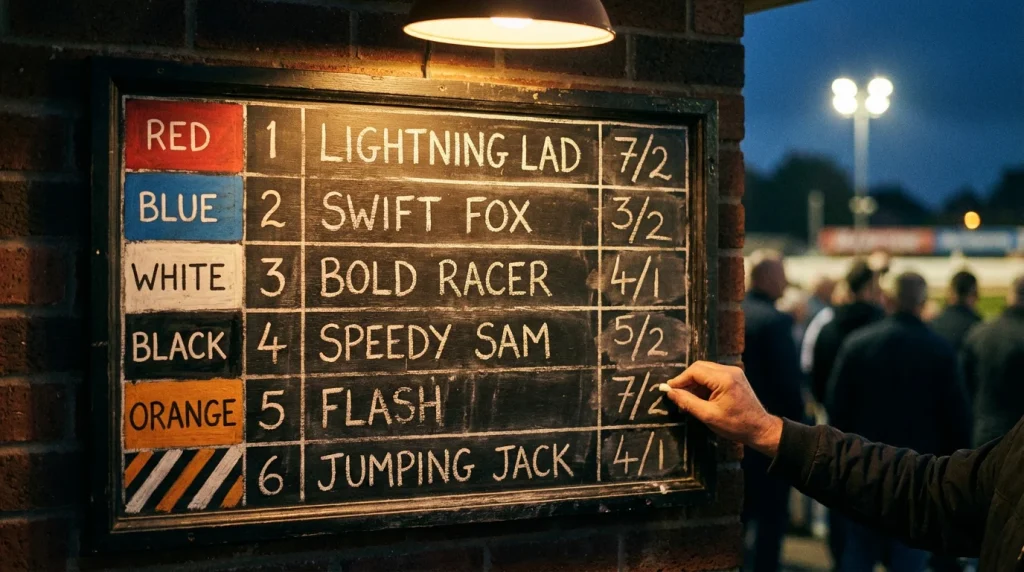
Odds Are the Language — Learn to Speak It
Every number on the screen is an opinion. Your job is to disagree profitably. Greyhound odds are not facts about a dog’s ability — they are the market’s collective assessment of each runner’s chances, expressed as a price. That assessment is sometimes right, sometimes wrong, and occasionally wildly off. The bettor who treats odds as negotiable positions rather than objective truths is already thinking more clearly than most of the money flowing through the ring.
Odds in greyhound racing serve two functions. The first is mechanical: they tell you what you stand to win relative to your stake. A dog at 4/1 returns four times your stake plus the stake itself. That part is arithmetic. The second function is informational: odds encode the bookmaker’s model of the race — which dogs are most likely to win, which are rank outsiders, and how much margin the bookmaker has built into the prices. Reading odds as information, rather than just as potential payouts, changes the way you approach every race.
The odds for a greyhound race are typically formed in the hour before the race, though early prices may be available from mid-morning on the day of the meeting. Unlike horse racing, where ante-post markets can open weeks in advance for major events, greyhound odds are compressed. Prices are set, move, and settle within a narrow time window — sometimes as little as 30 minutes for a BAGS meeting. That compression creates both risk and opportunity, because there is less time for the market to correct mispriced runners before the traps open.
Understanding how greyhound odds are displayed, how they move, and what they represent in probability terms is the foundation of any serious approach to betting on the dogs. The rest of this guide builds that foundation piece by piece.
Fractional, Decimal & How Greyhound Odds Are Displayed
Fractional odds are tradition. Decimal odds are clarity. Both say the same thing. UK greyhound racing has historically used fractional odds — the format you see on bookmaker boards at the track and on most traditional betting sites. Decimal odds, used widely in continental Europe and on betting exchanges, present the same information in a different format. Neither is superior; they are translations of each other. But understanding both allows you to move between platforms without confusion, and decimal odds have the advantage of making probability calculations faster.
The UK market is gradually shifting towards offering both formats, and most online bookmakers let you toggle between fractional and decimal in your account settings. Knowing how to read and convert between the two is not optional — it is basic fluency.
Reading Fractional Odds on a Greyhound Card
5/2 means £5 profit for every £2 staked. The first number is the potential profit; the second is the unit of stake. So 3/1 pays three pounds profit for every one pound wagered, returning four pounds in total (three pounds profit plus the one-pound stake). Evens, sometimes written as 1/1, means the profit equals the stake — bet £10 and you get £10 profit plus your £10 back.
Fractional odds below evens — known as odds-on — indicate a strong favourite. A dog priced at 4/6 requires a £6 stake to generate £4 profit. The total return is £10 (£4 profit plus £6 stake), which is less than double your money. Odds-on prices signal that the bookmaker considers the dog more likely than not to win, though in greyhound racing, where fields are small and upsets are frequent, odds-on favourites get beaten regularly enough that blind faith in short prices is a losing strategy.
The fractional system is intuitive once you are comfortable with it, but it has one practical disadvantage: comparing two prices like 11/4 and 5/2 requires mental arithmetic to determine which is bigger. For that reason, many serious bettors prefer to work in decimals.
Decimal Odds and Total Returns
3.50 means you get £3.50 back for every £1. Decimal odds include the stake in the figure, which makes calculating total returns immediate: multiply your stake by the decimal price, and you have the total payout. A £5 bet at 3.50 returns £17.50. A £5 bet at 1.67 (the decimal equivalent of 4/6) returns £8.35.
Converting between formats is straightforward. To turn fractional odds into decimal, divide the first number by the second and add 1. So 5/2 becomes (5 ÷ 2) + 1 = 3.50. To go the other way, subtract 1 from the decimal and express the result as a fraction: 3.50 minus 1 equals 2.50, which is 5/2.
Decimal odds also make it easier to estimate implied probability — the percentage chance the odds suggest a dog has of winning. Divide 1 by the decimal price and multiply by 100. A dog at 4.00 has an implied probability of 25%. A dog at 2.00 implies 50%. This calculation is the starting point for identifying value, because it translates the bookmaker’s price into a probability that you can compare against your own assessment.
Starting Price vs Early Price — When to Bet
The early price is set by the bookmaker. The SP is set by the market. Knowing which to take is half the game. The starting price — or SP — is the official price of a dog at the moment the traps open. It is determined by the on-course bookmakers (where they still operate) or by the industry SP mechanism, and it reflects the final state of the market after all money has been factored in. The early price, by contrast, is the price a bookmaker offers hours before the race, often from mid-morning on the day of the meeting.
Early prices in greyhound racing are set by the bookmaker’s traders, who assess the field based on form, draw, and historical data. These prices are their opening position — an educated guess that may or may not survive contact with the betting public. If punters pile money onto one dog, the bookmaker shortens its price and pushes out the prices of the other runners. If a dog attracts no interest, its price may drift outwards, sometimes significantly.
The question for bettors is when to commit. Taking the early price locks in a known return regardless of subsequent market movements. Taking the SP means accepting whatever the final market price turns out to be, which could be higher or lower than the early offering. In general, early prices are more attractive when you have identified a dog that the market has undervalued — if you believe the price will shorten as more money comes in, taking the early price secures a better return than waiting.
Conversely, if you suspect a dog might drift — perhaps it has a question mark over fitness, or the draw is less favourable than it looks — waiting for the SP gives the market time to incorporate information you might not have. There is no universal rule for which approach is better. The answer depends on the race, the dog, and your confidence in your own assessment. What matters is that you make the choice deliberately rather than defaulting to one approach out of habit.
One important detail: not all bookmakers offer early prices on every greyhound race. BAGS meetings and lower-grade evening cards may only have SP betting available, with no early market. Check what is available before you plan your betting strategy for a particular meeting.
Timing matters more than most punters realise. The window between the early prices appearing — typically around 10am for an evening card — and the first significant wave of money arriving is where value bets are most likely to exist. By mid-afternoon for an evening meeting, the early price on well-fancied dogs has usually shortened as money accumulates, and the best of the value has been absorbed by the market. If you are serious about exploiting the early-price window, build your form assessment the night before or early in the morning, so you are ready to act when the prices first appear rather than scrambling to catch up once the market has already moved.
Best Odds Guaranteed — Free Money or Marketing?
BOG means you always get the higher of your price and the SP. It sounds generous — and it is. Best Odds Guaranteed is a promotional feature offered by several major UK bookmakers on greyhound racing. The principle is simple: if you take an early price and the SP turns out to be higher, the bookmaker pays you at the better price. If the SP is lower, you keep your early price. Either way, you get the more favourable outcome.
The practical effect of BOG is that it removes one of the main risks of betting early. Without BOG, taking an early price carries the risk that the market moves against you — you lock in 3/1 and the dog drifts to 5/1 by the off, meaning you could have had a significantly better return. With BOG, that scenario works in your favour. You took 3/1, the SP is 5/1, and the bookmaker pays you at 5/1.
Bookmakers offer BOG because it encourages early betting, which helps them manage their liabilities and shape the market before the race. It is a genuine benefit for punters, but it is not limitless — most BOG offers apply only to single win bets, and some bookmakers cap the maximum payout uplift or exclude certain meetings. Always check the terms before assuming BOG applies to your bet.
From a strategic perspective, BOG makes early-price betting the dominant strategy whenever it is available. If the early price offers value and BOG is in play, you are protected against missing a bigger SP. The only reason to prefer SP in a BOG environment is if no early price is offered or if you genuinely have no view on the race and want the market to do the thinking for you.
To see how much BOG can be worth across a season, consider the arithmetic. If you place 200 bets over a year and BOG upgrades the payout on 30 of the winners — boosting them from the early price to a higher SP — those upgrades represent free profit. On a typical upgrade of two points (say, from 4/1 to 6/1), a £10 stake gains an extra £20. Thirty such upgrades add £600 to your annual returns for doing nothing more than choosing bookmakers who offer the guarantee. It is not a strategy in itself, but it is a tailwind that no serious greyhound bettor should ignore.
Why Greyhound Prices Move Fast — And What It Means
A greyhound market can swing 3 points in 90 seconds. Unlike horse racing, where major race markets are shaped by thousands of bettors over hours or days, greyhound markets are thin. The total money wagered on a single race at a Tuesday BAGS meeting is a fraction of what flows through a Saturday horse racing handicap. That low liquidity means that relatively small amounts of money can cause significant price movements.
When a dog shortens sharply in the final minutes before a race — from 5/1 to 3/1, say — it usually means that someone with a sizeable stake has backed it. That someone might be the trainer’s connections, a professional bettor who has spotted something in the form, or simply a punter who fancies the dog. The cause is not always knowable, but the effect is visible: the price contracts, and the prices of the other dogs in the race push out to compensate.
Drifting prices — where a dog’s odds lengthen in the run-up to the off — can be equally informative. A drift sometimes indicates negative information: the dog might be returning from a break, or word might have circulated that it did not trial well. But drifts can also be structural, caused by money flooding into a rival rather than any issue with the drifting dog itself. Distinguishing between a genuine negative drift and a passive one requires context — is the dog’s price moving because people are avoiding it, or because they are backing something else?
The speed of greyhound market movements makes live monitoring valuable. If you are betting on evening cards or BAGS meetings, watching the market in the five minutes before each race gives you a real-time feed of sentiment. Sudden, late shortening of a 6/1 or 8/1 shot is often the most telling move — it suggests confidence from people who typically know more than the public market.
One practical consideration: if you spot a market move and want to act on it, speed matters. Greyhound markets move fast enough that a price you see at 7:14pm may not be available at 7:15pm. Online bookmakers with live-updating odds are the best way to track and react to these shifts.
Finding Value — A Practical Framework
Value isn’t about finding winners. It’s about finding prices that overestimate the loser’s chances. This distinction is the single most important concept in profitable betting, and it is the one that most punters never fully internalise. A dog at 6/1 that wins 20% of the time is a value bet, because the price implies a 14% chance while the true probability is significantly higher. A dog at evens that wins 45% of the time is a losing bet in the long run, because you are paying for a 50% implied probability that the dog does not deliver.
Value is a relationship between price and probability, and you cannot assess it without estimating both. The price is given to you by the bookmaker. The probability is something you have to estimate yourself, using the form, the draw, the track, the sectional data, and every other piece of information available on the racecard. Your estimate will not be precise — nobody’s is — but it does not need to be. It needs to be roughly right often enough that the prices you take, on average, understate the chances of your selections.
The practical challenge is calibration. Most people overestimate their ability to identify winners and underestimate the frequency with which they are wrong. The antidote is to think in terms of ranges rather than certainties. Instead of deciding that a dog has a 25% chance of winning, ask yourself whether it falls in the 20-30% range. If the bookmaker’s price implies 15%, the bet has value even at the conservative end of your estimate. If the price implies 25%, you are betting at fair value at best, and there is no edge.
How to Estimate True Probability from Form
Convert your assessment to a percentage. Convert the odds to a percentage. Compare. The method is deceptively simple, and the execution is where skill enters. Start by reviewing the racecard — form, draw, sectional times, grade, trainer — and forming a view on each dog’s chances. You do not need to assign an exact probability to every runner. Focus on the dogs you consider serious contenders and estimate a rough percentage for each.
A practical way to calibrate is to start with the favourite and work outwards. If the market favourite looks like a genuine 35% chance to you — it wins roughly one in three times this race is run — then the remaining 65% is shared among the other five dogs. If one of those five has strong form, a good draw, and fast sectionals, it might deserve 20-25% of that remaining probability. If the bookmaker has priced it at 8/1 (an implied 11%), you have a significant discrepancy between your estimate and the market’s. That discrepancy is value.
This approach will not produce winners every night. It will not even produce positive returns every week. What it does, over a sustained period, is ensure that the prices you bet at are systematically better than fair. If you are consistently taking 8/1 about dogs you believe have a 20% chance, the mathematics will work in your favour over a large enough sample. The key word is consistently — value betting is a long-term strategy, not a quick fix.
The Price Is Right — Or You Walk Away
Discipline on price separates punters who last from punters who don’t. Every serious greyhound bettor will tell you the same thing: the hardest skill is not finding good dogs — it is walking away when the price does not justify the risk. You can identify the right dog, in the right race, at the right track, with the right form and the right draw, and still make a bad bet if the price is too short.
The temptation to back a dog you fancy regardless of the price is powerful. You have done the work, you believe in the selection, and the race is about to start. But if the bookmaker’s price implies a 40% chance and your assessment says 35%, you are paying more than the selection is worth. Over a single bet, the difference is negligible. Over hundreds of bets, it is the difference between a positive return and a slow, steady drain on your bankroll.
A practical rule is to set a minimum acceptable price before you look at the market. Study the racecard, form your view, estimate the probability, and convert that estimate into a price threshold. If the market offers that price or better, you bet. If it doesn’t, you move on. This eliminates the psychological pull of wanting to bet on a race because you have already invested time in analysing it. The analysis is valuable regardless of whether it leads to a bet — it sharpens your judgement, builds your familiarity with the track, and informs future assessments even when the current price is wrong.
There will always be another race. There will always be another meeting. The fixture list runs every day of the week, 52 weeks a year. The supply of opportunities is effectively unlimited. The supply of good-value opportunities is not, and those are the only ones worth taking. Price discipline is not passive — it is the most active and consequential decision you make as a bettor. Everything else is preparation. The price is the moment of truth.
Find more odds guides at greyhoundmeetings.
Also read our best odds guaranteed on greyhounds.
